FTMO Review 2026: Is It Still the Biggest Prop Firm?
On size, platform choice and the amount it tells you before you pay, FTMO is still the firm the rest of the industry is measured against. But it is also no longer the firm most reviews describe. The 30- and 60-day deadlines are gone, three paid routes have replaced the single challenge, and since December 2025, FTMO has owned the broker OANDA.
It suits a patient trader who can reach a 10% target without one outsized day, and it has written that preference into its rules. One detail decides more than any other: the two-step fee is returned with your first payout, and the fees on the other two routes are not returned at all.
Figures here come from FTMO's pricing panel and rule pages on 16 October 2026. We did not take them from aggregators, three of which quote different prices for the same account. For how FTMO's rules sit against its rivals line by line, read our guide to prop firm rules.
Key Takeaways
- Three paid routes, one standard: The 1-Step, 2-Step, and Instant accounts share a 10% maximum loss and differ on almost everything else.
- Only one fee comes back: FTMO marks the 2-Step fee as refundable at 100%. The 1-Step and Instant fees are listed as non-refundable.
- Instant access is expensive: A $100,000 Instant account costs €2,999 against €540 for the same size on the 2-Step.
- No deadlines: Neither challenge carries a time limit, which removes the pressure that ended most attempts under the old model.
- US traders are accepted again: FTMO serves them through its OANDA entity, under requirements stricter than the main site's.
FTMO Review: Company Overview
Otakar Šuffner and Marek Vašíček founded FTMO in Prague in 2015 while still at university. The company trades as FTMO s.r.o., says it employs more than 300 people and reports 4.5 million customers across 140 countries. It puts lifetime rewards above $650m, and Finance Magnates reported $14.4m of that going out across roughly 7,100 payouts in September 2026 alone.
The structural change came on 1 December 2025, when FTMO completed its purchase of OANDA from CVC. Finance Magnates later put the price at $422m. OANDA still trades under its own name; its prop clients moved across in March 2026, and the two FTMO founders took over as its co-chief executives. A prop firm owning a regulated broker is rare, and it explains the US arrangement described below.
DETAIL | FTMO |
Founded | 2015, Prague, Czech Republic |
Legal entity | FTMO s.r.o. (US service via JV Prop Corporation and OANDA Prop US Corporation) |
Founders | Otakar Šuffner (CEO), Marek Vašíček (CTO) |
Account sizes | $5,000 to $200,000, depending on route |
Evaluation routes | 1-Step, 2-Step, Instant, plus a free trial |
Profit split | 80% to 90% |
Platforms | MT4, MT5, TradingView, FTMO, cTrader |
Rewards paid | $650m+ since 2015, self-reported |
Trustpilot | 4.8 out of 5 from 54,479 reviews |
Is FTMO Legit? What the Record Shows
FTMO holds 4.8 out of 5 on Trustpilot across 54,479 reviews, with 92% at five stars. We found no regulatory action, lawsuit, or enforcement against the firm in Czech, EU, or US records.
Three things go with that: FTMO has not published audited breakdowns of its payout totals, so the $650m rests on its own accounting. Šuffner told TradeInformer that roughly 10% of challenge takers pass, and the firm does not break that down by route. And FTMO states on its own site that none of this activity is overseen by a financial regulator and that all trading is simulated, which is the most important sentence on the website.
FTMO Challenge Rules: 1-Step, 2-Step and Instant
Every route caps the overall loss at 10% of the starting balance. How that cap behaves is where they separate, and it decides which one is survivable for your style.
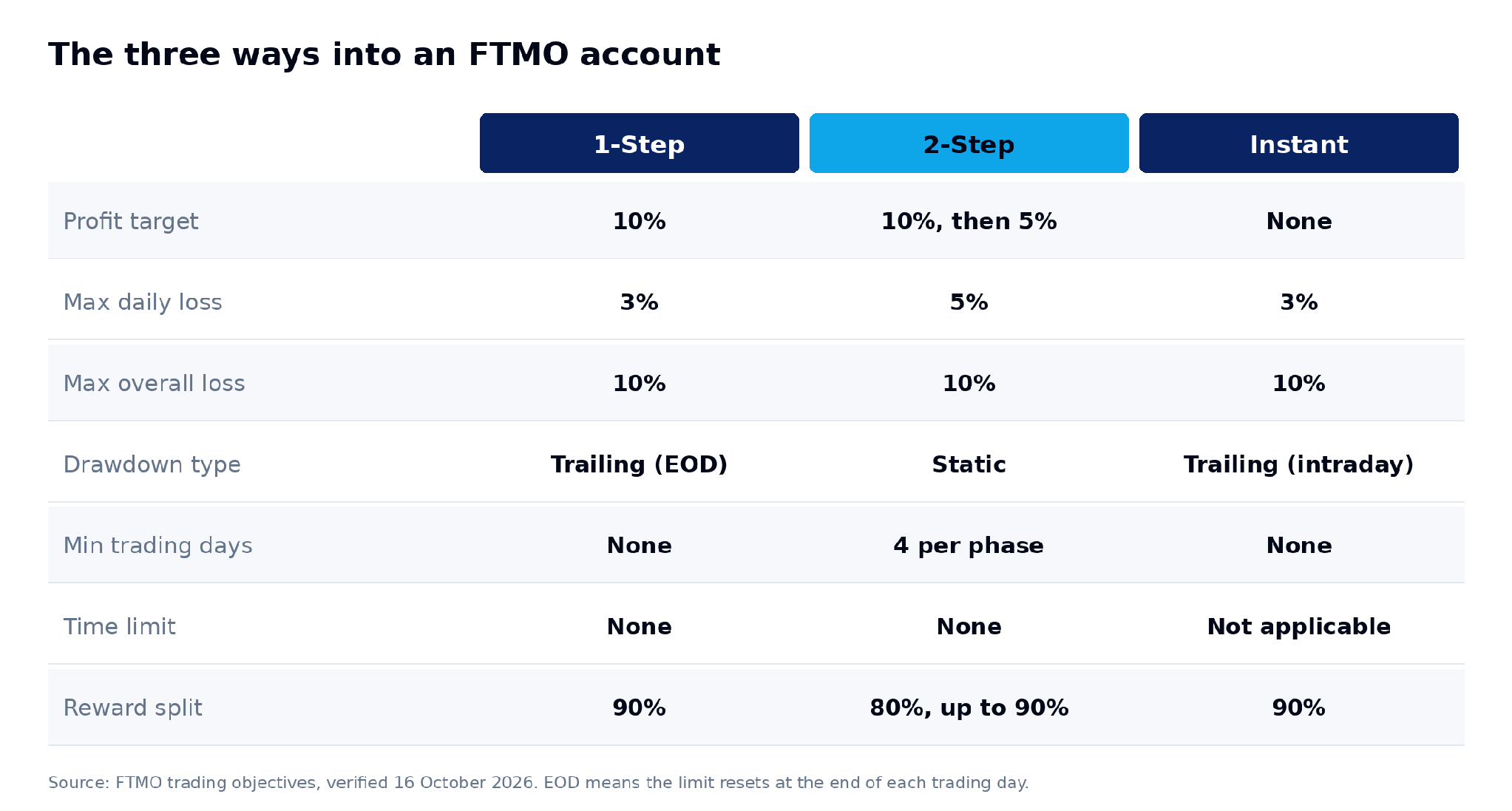
On the 2-Step, that limit is static. It dwells at 90% of your opening balance and stays there, whatever you earn. On the 1-Step, it trails your closing balance each day, so profits lock in overnight and the floor rises with them. On the Instant account, it trails intraday, meaning an unrealised gain can lift the floor beneath a position you still hold. Daily loss limits differ too: 5% on the 2-Step against 3% on the other two. The full rule set sits on FTMO's trading objectives page.
Before paying for any of them, there is a free trial running up to $200,000, without any time limit or cap on attempts. A fortnight there costs nothing and teaches you which floor you can live with.
What the FTMO Challenge Costs
Each account is priced once, up front. Below are list prices in euros, taken from the pricing panel on 16 October 2026. Discounts run often, and a 20% promotion was live on the $100,000 1-Step when we checked, so read these as a ceiling. You may well pay less.
ACCOUNT | 2-STEP | 1-STEP | INSTANT |
$5,000 | n/a | n/a | €169 |
$10,000 | €89 | €79 | €339 |
$25,000 | €250 | €199 | €749 |
$50,000 | €345 | €319 | €1,499 |
$100,000 | €540 | €499 | €2,999 |
$200,000 | €1,080 | €999 | n/a |
Fee returned? | Yes, 100% | No | No |
FTMO list prices in EUR, verified 16 October 2026. Prices quoted in other currencies will differ.
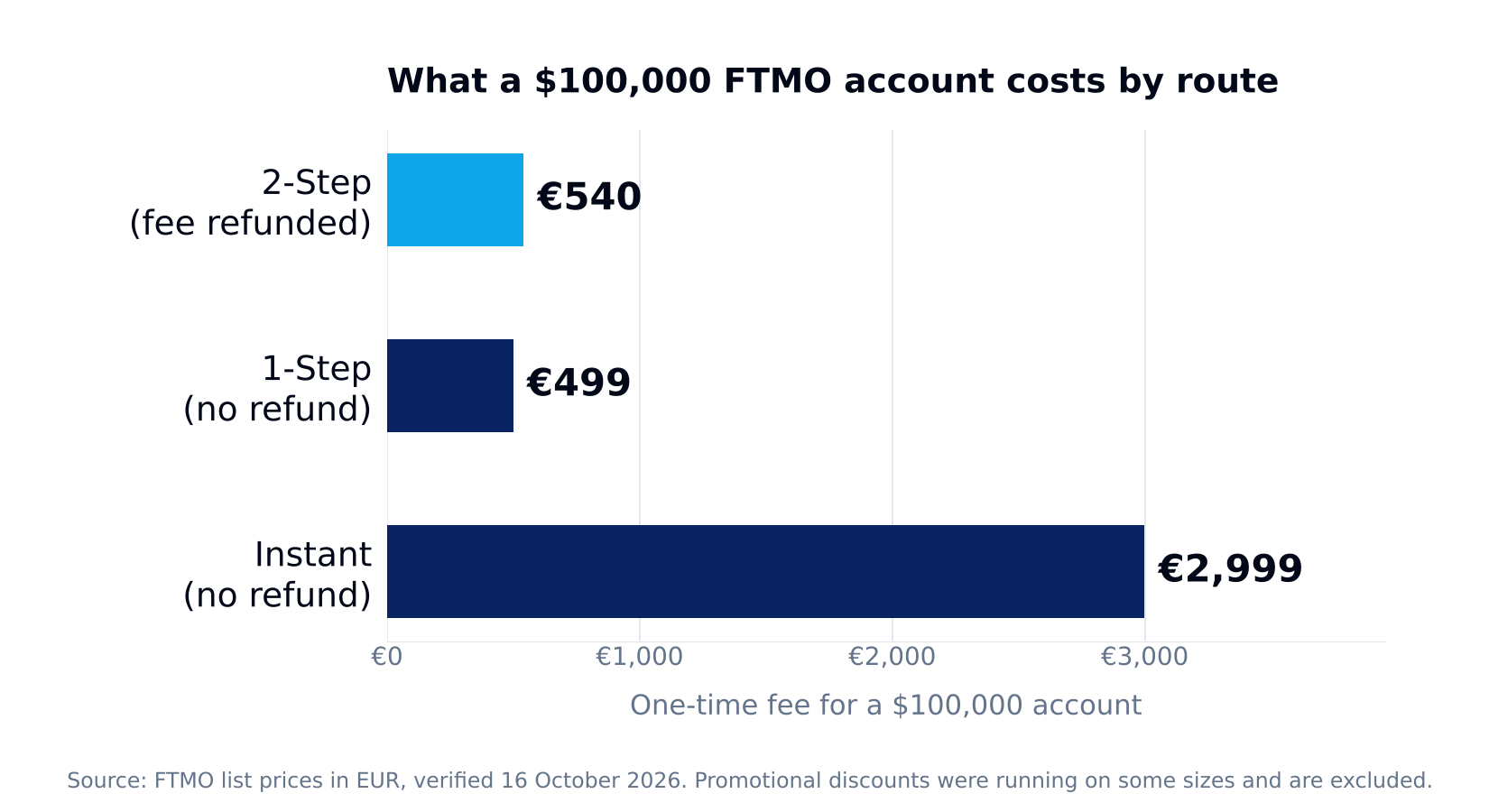
The refund line is where the aggregators disagree with each other, and FTMO's own panel settles it: the 2-Step fee returns in full with your first reward, and the other two are marked non-refundable. So a 1-Step account looks €41 cheaper at $100,000 and is not. Reach a payout on the 2-Step and the entry has cost you nothing. Reach one on the 1-Step, and it has cost you €499.
FTMO Payouts: Splits, Schedule and Scaling
The 2-Step starts you on 80% of profits, rising to 90% through the Scaling Plan or the Premium Programme. The 1-Step and Instant accounts pay 90% from the first reward, which is part of what the non-refundable fee buys.
A first payout becomes available 14 days after your first trade, and after that you request them when you want, with a profit split day you set yourself. Payment goes by bank transfer, Visa Direct, Mastercard Send, Skrill, or crypto, and approval plus transfer usually takes two to four working days in total.
Scaling takes longer than the headline 25% suggests. It needs four months as an FTMO trader, at least 10% net profit across that window, two processed rewards, and a positive balance. Clear all four and the account grows by a quarter, with the same test every four months after that, up to a $2m ceiling across all your accounts. Instant accounts are excluded. Our guide to prop firm scaling plans sets out how that compares across the industry.
Platforms, Instruments and the MetaTrader Question
CFD accounts run on MT4, MT5, TradingView or a white-labelled cTrader. That choice matters because of February 2024, when MetaQuotes tightened its licensing around prop firms. Finance Magnates reported at the time that FTMO lost its MetaTrader servers for American clients and stopped taking US sign-ups, while leaving existing accounts open. MT5 returned for US traders in August 2025, through a partnership with OANDA that preceded the acquisition by several months.
Coverage runs to roughly 80 instruments across forex majors and exotics, metals, indices, energies, crypto and share CFDs. FTMO publishes no count of its own, so that comes from third-party tallies. There is no proprietary terminal, though a mobile app and a client area with trade analytics come with every account. FTMO Futures, a separate product launched in September 2026, runs on Tradovate, NinjaTrader, and TradingView.
Can US Traders Use FTMO?
Yes, and much of the internet still says otherwise. Americans are routed to a service run with OANDA, where the evaluation sits with JV Prop Corporation and the funded account with OANDA Prop US Corporation. Australian traders go through a comparable affiliate arrangement under its own entity and terms.
The conditions are stricter than the main site's. You need a US tax ID, a W-9 filed before the first reward, and a fully licensed US bank account, since fintech and digital-only providers are refused. That last point catches people who bank entirely through an app. US entities registered in Arkansas, Delaware, Louisiana, Montana, or South Carolina are not accepted at all, and the US service runs on MT5 and TradingView only.
The Rules That Catch Traders Out
Forbidden practices are published in full, which is more than many firms manage. Four of them account for most avoidable failures.
The consistency rule changed on 12 October 2026: For 1-Step orders placed from that date, a single best day may account for no more than 50% of total profit. Earlier accounts are measured differently, so every guide written before this month describes the old calculation. Breaching it does not fail you; it freezes your progress until further trading brings you back inside the limit. Instant accounts face a tighter 30% version, reset after each withdrawal.
Expert advisors are allowed, within a cap: Anything sending more than 2,000 server requests in a day counts as hyperactive and breaches the rules, a ceiling scalping bots reach without difficulty.
Opposite positions across accounts are banned: Hedging inside one account is fine. Doing it across two FTMO accounts, or between FTMO and another firm, counts as manipulation.
News and gap trading are restricted: You may not open a position when major news or earnings are scheduled, nor within two hours of a market closing for a long break, which is what catches traders on a Friday afternoon.
What our team watches on an FTMO account
- The overnight floor on 1-Step. A profitable Tuesday raises Wednesday's loss limit. Traders who learned the static 2-Step rule carry the wrong mental model across and get stopped out early.
- Target speed against the consistency rule. Those who reach the profit target fastest tend to breach consistency instead. Spreading it across six or seven sessions is slower and finishes more often.
- Partial closes on the Instant account. With the drawdown trailing intraday and resetting after withdrawals, the sequence in which you take profit changes where your floor sits.
- Automation request volume. The 2,000 request ceiling counts every server call, not every trade, so a busy indicator can breach it while placing very few positions.
FTMO vs FundedNext, FundingPips and The5ers
FTMO is rarely the cheapest entry and rarely the most generous split on paper. What it has instead is scale, round-the-clock support in 21 languages and, since the OANDA purchase, a broker on the same balance sheet.
FIRM | $100K ENTRY, AS QUOTED | PROFIT SPLIT | DISTINGUISHING FEATURE |
FTMO | €540 (2-Step, refunded) | 80% to 90% | Four platforms, owns OANDA |
FundingPips | About $652 | 60% to 100% | Split rises the longer you wait to withdraw |
FundedNext | Not published per model | 80%, 95% paid add-on | Accounts from $6,000 |
The5ers | About $405 | Up to 100% | Three tiers, split-fee bootcamp |
Competitor figures are indicative, drawn from third-party pricing checked in October 2026 rather than from each firm directly, and are quoted in the currency each source used. Verify before you buy.
FundedNext opens accounts well below FTMO's $10,000 floor and sells a higher split as a paid extra. FundingPips ties your split to how long you wait. The5ers asks less at $100,000 and runs a more complicated ladder to get there. Our Funding Pips review covers that firm in the same detail.
FTMO Review: Pros and Cons
Pros
Removing time limits took away the pressure that ended most attempts under the old model, and the free trial lets you test a route before committing. Four platforms offer more choice than most CFD rivals offer, and both MetaTrader versions survived the 2024 licensing squeeze. Support runs around the clock in 21 languages. The forbidden practices are published in detail instead of being buried, and that is why this review can be specific about them.
Cons
The Instant account costs more than five times the 2-Step for the same size and returns nothing. Scaling demands four months and two payouts before the first increase. The consistency rule, tightened this month, works against exactly the trading style that draws people to prop firms. None of the activity is regulated, the payout totals are unaudited, and on the firm's own figures, around nine in ten entry fees stay with the company.
FTMO Review: The Bottom Line
FTMO earns the benchmark position on scale, platform choice, and how much it publishes before you pay, and owning OANDA gives it a structure none of the three firms above can match. That is a statement about the business, not about your odds, which remain roughly one in ten.
If you buy anything, buy the 2-Step, because it is the only route that returns the money. Spend time on the free trial first. The 1-Step is a paid shortcut, and the Instant account is built for traders who already know they can hold a 3% daily limit with the floor moving underneath them. Read the consistency rule before the first position rather than after the best day. Our guide to passing a prop firm challenge covers the preparation.
Prices, rules, and country terms were verified on 16 October 2026, and FTMO revises them regularly. Check the live figures before paying.
Frequently Asked Questions
Is FTMO legit?
FTMO has traded since 2015, and we found no regulatory action or lawsuit against it. The qualification worth holding onto is that it is not a regulated broker and the trading is simulated, so the consumer protections attached to a brokerage account do not apply here.
Is FTMO available in the USA?
Yes, through a separate service FTMO operates with OANDA rather than through the main site. The eligibility conditions are tighter than elsewhere, and entities registered in five states are refused outright. The section above sets out what you need.
How much does the FTMO Challenge cost?
List prices run from €79 for a $10,000 1-Step account to €1,080 for a $200,000 2-Step. Instant accounts sit far above both, starting at €169 for $5,000. Only the 2-Step fee comes back, and discounts run frequently.
How long do FTMO payouts take?
The first request opens 14 days after your first trade, then whenever you choose. Expect two to four working days from request to money arriving, by bank transfer, card, Skrill, or crypto.
What is the FTMO pass rate?
Around 10%, as per the chief executive's own public figure. FTMO does not publish a breakdown by account size or route, so treat it as an order of magnitude.
Is FTMO better than FundedNext?
It depends on budget. FundedNext opens smaller accounts and sells a 95% split as a paid extra. FTMO asks more at entry, gives the fee back on the 2-Step, offers four platforms, and is a substantially larger business.