Everything You Need to Know About Prop Firm Scaling Plans
Learn how a prop firm scaling plan works, including profit targets, drawdown rules, consistency requirements, and account growth strategies.

You've passed the evaluation. The funded account is active. Now the firm is offering to double your capital if you hit the next target. Sounds straightforward. It usually isn't.
Scaling plans are where prop trading gets interesting — and where a lot of traders either stall or get caught off guard by requirements they didn't read carefully enough at the start. Understanding the mechanics before you're already inside a scaling evaluation changes how you approach risk from day one.
Here's what a prop firm scaling plan actually is, how the different requirements work, and what separates the traders who build through multiple tiers from the majority who plateau somewhere in the middle.
What Is a Prop Firm Scaling Plan?
A scaling plan is a firm's structured framework for increasing a trader's capital based on performance. Pass the evaluation, get funded, hit specific performance metrics over a defined window, receive a larger account. That's the basic loop.
The "larger account" part is where it gets complicated. Some firms offer scaling as a formal program with documented criteria and guaranteed capital increases. Others frame it as discretionary — they review your performance and decide whether to extend more capital. The distinction matters. Guaranteed scaling plans give you clear milestones to work toward. Discretionary plans leave you uncertain about exactly what you're trading toward.
Most serious prop firms have moved toward guaranteed scaling structures. If the scaling terms aren't published in clear, specific numbers before you buy an evaluation, that's worth paying attention to.
How Scaling Plans Actually Work
The mechanics differ by firm, but the underlying structure is consistent: demonstrate you can manage risk at your current account size, and you earn access to more capital.
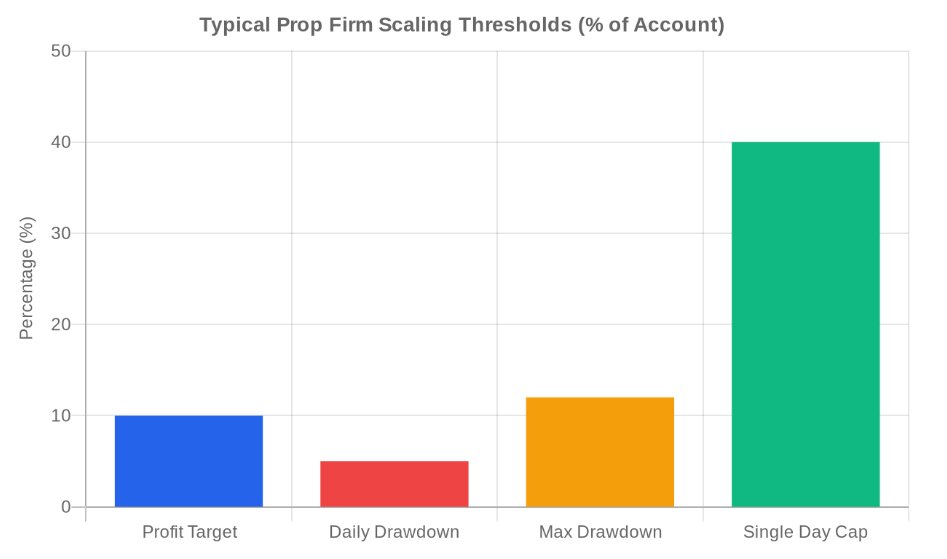
A typical progression: start at $50,000, hit a 10% profit target over 60 days while staying within the drawdown rules, and the firm increases your account to $75,000. Hit the same requirements at the new level, move to $100,000. Then start again at the next tier.

What triggers the review varies. Most firms run evaluations at fixed intervals — 60 days is the most common window. Some automatically trigger a review when you hit the profit target. Others require you to request one.
Traders who know their exact review window from day one — and treat the evaluation period as a defined sprint rather than open-ended trading — approach position sizing more carefully. Knowing you have 60 days focuses the work. That's not a psychological trick. It's a practical constraint that shapes decisions.
The Four Requirements That Determine Whether You Scale
Profit Targets
The most visible requirement. Most firms set a 5-10% profit target on the account balance within the evaluation window. Some use tiered targets — slightly lower percentages for larger accounts where the absolute dollar figure is already meaningful.
What catches traders off guard: the profit target and risk compliance both have to hold simultaneously. Hitting 10% profit while briefly touching the max drawdown threshold during the process typically disqualifies the scaling review. The target and the rules aren't independent — both are evaluated together, for the full window.
Daily Drawdown Limits
This ends more scaling attempts than profit targets do. A 5% daily drawdown limit on a $100,000 funded account means a $5,000 intraday loss closes the account for the day. One session. One bad entry on a news release. One position sized for the old account but not the current one.
The discipline required at $100,000 is different from what worked at $10,000. Position sizing that passed the evaluation can breach daily limits at scale if the trader doesn't rebuild their risk framework when the capital increases.
Consistency Requirements
This is the requirement that catches traders who hit their profit target quickly and then trade aggressively to extend gains. Most firms cap how much of total monthly profit can come from a single trading day — commonly in the 30-50% range.
Made $8,000 total but $5,000 came in one session? Depending on the firm's specific consistency rule, that month may not qualify — regardless of total profit. Firms want repeatable edge, not a single event that happened to go well.
Minimum Trading Days
Many firms require 15-20 active trading days within the evaluation window. A handful of massive winning days with long inactive stretches between them doesn't demonstrate the sustained performance profile firms are evaluating. It's a baseline consistency check, but it catches traders who treat the account like a lottery ticket rather than a business.
What Account Progression Actually Looks Like
MyFundedFutures published internal data covering January 2024 through July 2025 showing that just 1.01% of simulation participants advanced to live funded accounts. That figure covers the full pipeline — sign-up, evaluation, and into active trading — not just the pass/fail rate on individual challenges. The attrition at each stage is steep.
Most traders who lose funded accounts do it early. Often within the first two weeks of receiving a larger account, before they've recalibrated their position sizing to the new capital level.
A realistic timeline for a consistent trader:
- Months 1-3: Pass evaluation, get funded at $25K-$100K depending on the plan purchased
- Months 4-6: First scaling review opens; the gap between profitable and qualifying (profit AND full rule compliance) becomes visible
- Months 7-12: Traders who scaled once reach $100K-$200K accounts; the difference between profitable and disciplined becomes the key variable
- Year 2+: Elite-tier accounts above $500,000 are available at some firms but require sustained performance across 12+ months at intermediate tiers
Six months from evaluation to $100,000 is achievable. It's also faster than average. Most traders who reach meaningful funded capital have gone through multiple evaluation attempts before they lock in the position sizing and risk approach that holds up across a full review window.
Why Most Traders Don't Scale
Position sizing doesn't automatically adjust when the account doubles. That's the direct answer.
A trader comfortable risking 1% per trade on a $10,000 evaluation account — $100 per trade — will often instinctively maintain the same percentage on a $100,000 funded account. That's $1,000 per trade. Five consecutive losses, each within normal expected drawdown for their strategy, puts $5,000 at risk in a session. At most funded firms, that's the daily drawdown limit.
The traders who build through multiple scaling tiers treat each new account size as a different instrument. They rebuild position sizing from scratch at each tier. They reduce leverage rather than maintaining it. The number of active trading days per month often increases as the account grows — because the goal shifts from maximising short-term profit to demonstrating controlled performance over a defined window.

There's also a psychological dimension that most traders underestimate until they're in it. Managing $10,000 in evaluation capital doesn't create much real financial stress. Managing $200,000 in a funded account — where a rule breach means losing access to that capital — does. That stress shows up in premature trade exits, revenge trading after a losing session, and oversizing after a winning streak. Any of these will fail a scaling review at exactly the wrong moment.
Frequently Asked Questions
Do all prop firms offer scaling plans?
No. Some cap accounts at the initial funded amount with no formal scaling program. Others mention scaling without publishing specific criteria. Before buying any evaluation, check that the scaling terms are documented with exact numbers — not just referenced as a possibility.
What happens if I break a drawdown rule while I'm above the profit target?
The account is suspended or closed depending on the rule. Reaching max drawdown while sitting on an 8% monthly profit doesn't preserve the account. Risk rules are absolute and aren't conditioned on your current P&L position.
How long does scaling from $50K to $200K typically take?
With 60-day review periods and a reasonable pass rate, the realistic minimum is 12-18 months. Faster timelines exist but usually involve more evaluation restarts along the way.
What's the consistency rule most traders overlook?
The single-day profit cap. Most traders focus on the profit target and drawdown limits and miss the rule restricting how much of total monthly profit can come from one session. At firms where the cap is 30-40%, one exceptional trading day can disqualify the entire month regardless of cumulative profit.