Prop Firm Rules: Every Challenge Rule You Need to Know
Understand every prop firm rule before you trade — drawdown types, daily loss caps, banned strategies, and how the top firms compare in 2026.
What Are the Main Prop Firm Rules in Challenges?
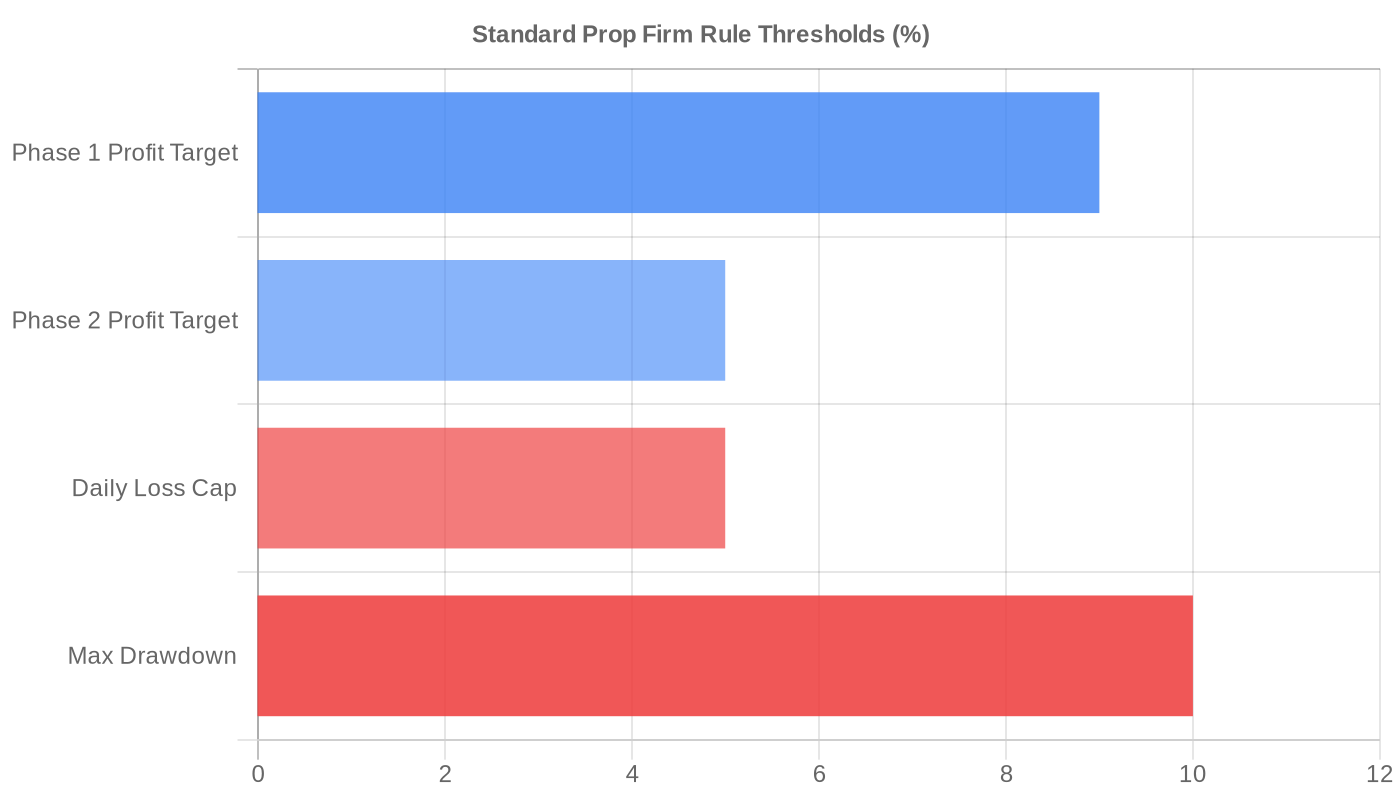
Prop firm challenges test your trading discipline through a fixed set of ‘Prop Firm Rules’: profit targets (typically 8-10%), daily loss limits (3-5%), and maximum drawdown caps (5-10%). According to a 2025 FPFX Tech analysis of 300,000 accounts, only 7% of all participants ever reach a payout — most fail not from poor strategy but from breaking these rules. Knowing them before you trade isn't optional.
You're two weeks into a $50,000 prop firm evaluation. Your strategy is working — you're up 6%, inside the profit target range, and the funded account feels close. Then Wednesday happens. A bad morning session bleeds into the afternoon. You keep trading, hoping to recover. By 3pm, you've breached the 5% daily loss limit. Challenge over. Fee gone.
That scenario plays out thousands of times a week across the prop firm industry. The rules didn't change. The trader just didn't know where the floors were — or didn't respect them when it mattered.
This guide covers every major rule category you'll encounter, how they're calculated, and which ones most commonly end challenges early.
"The biggest mistake evaluation traders make is treating the daily loss limit as a target rather than a hard floor. Once you start trading to recover, you've already failed the risk management test the firm is actually running." — Dr. Brett Steenbarger, Trading Coach and Author of The Psychology of Trading
Rules at a Glance
Rule | What It Means | Typical Range | Calculation Method | Breach Consequence |
Profit Target | Minimum gain required to pass each phase | Phase 1: 8–10% / Phase 2: 5% | % of initial account balance | Phase incomplete — cannot advance |
Daily Loss Limit | Maximum loss permitted in a single trading session | 3–5% of account size | Balance or equity (firm-specific) | Immediate session lockout; challenge terminated |
Maximum Drawdown | Total cumulative loss allowed from account peak | 5–10% of account size | Static (from opening balance) or Trailing (moves with equity high) | Immediate account termination |
Consistency Rule | Caps how much of total profit can come from one session | 30–40% of total profit target per day | % of cumulative evaluation profit | Excess profit may not count; some firms terminate |
Minimum Trading Days | Minimum number of active sessions required within the evaluation window | 5–10 days per phase | Days with at least one executed trade | Cannot pass phase without meeting minimum |
Time Limit | Maximum calendar days to complete each phase | Phase 1: 30 days / Phase 2: 60 days | Calendar days from account activation | Evaluation expires; fee forfeited |
Daily Profit Cap | Limits how much profit counts from a single session | 20–30% of total profit target | % of total required profit target | Excess profit above cap excluded from target |
Inactivity Rule | Funded account deactivated after prolonged no-trading period | 30 days without a trade | Calendar days since last executed trade | Funded account deactivated |
News Trading Restrictions | Limits or bans opening/closing trades around high-impact news events | Typically ±5 minutes around scheduled events | Time proximity to high-impact calendar events | Profits voided; potential disqualification |
Prohibited Strategies | Bans specific trading methods deemed exploitative | HFT, Martingale, Grid, Cross-account hedging | Detected via platform monitoring | Immediate disqualification regardless of performance |
EA / Automated Trading | Governs use of bots, EAs, and copy trading | Allowed with restrictions at most firms | Strategy classification (HFT vs standard automation) | Disqualification if classified as prohibited automation |
How Prop Firm Challenges Are Structured
Prop firm challenges are evaluation accounts — simulated trading environments where your performance is measured against a fixed ruleset before the firm trusts you with real capital. The prop firm market is valued at $7.14 billion in 2026, growing at 10.9% annually (Business Research Insights, 2026), which tells you something about how mainstream this route to capital has become.
The evaluation structure comes in two main formats.
1-Step vs. 2-Step Challenges
- One-step challenges require you to hit a single profit target and stay within risk limits — pass once, get funded. They're faster but typically carry tighter profit targets relative to drawdown limits.
- Two-step challenges are the industry standard. Phase 1 sets a higher profit target (usually 8-10%) with a longer window. Phase 2 drops the target (typically 5%) and acts as a verification stage — the firm confirms your Phase 1 results weren't a lucky week. After both phases, you access a funded account and start splitting profits with the firm.
Account sizes typically run from $5,000 to $200,000. Profit splits on funded accounts range from 50% to 95%, with the higher-end splits usually tied to scaling plans that grow your allocation as you hit performance milestones.
What the Simulated Account Actually Measures
The rules don't care about your strategy. They measure whether you can manage risk consistently under pressure. That's the whole test. The firm needs to know that when real capital is on the line, you won't blow past drawdown limits trying to recover a bad day.

What Is the Maximum Drawdown Rule?
Maximum drawdown is the total loss your account can sustain from its peak before the challenge is terminated. This is the rule that catches the most traders off guard — particularly the trailing variant.
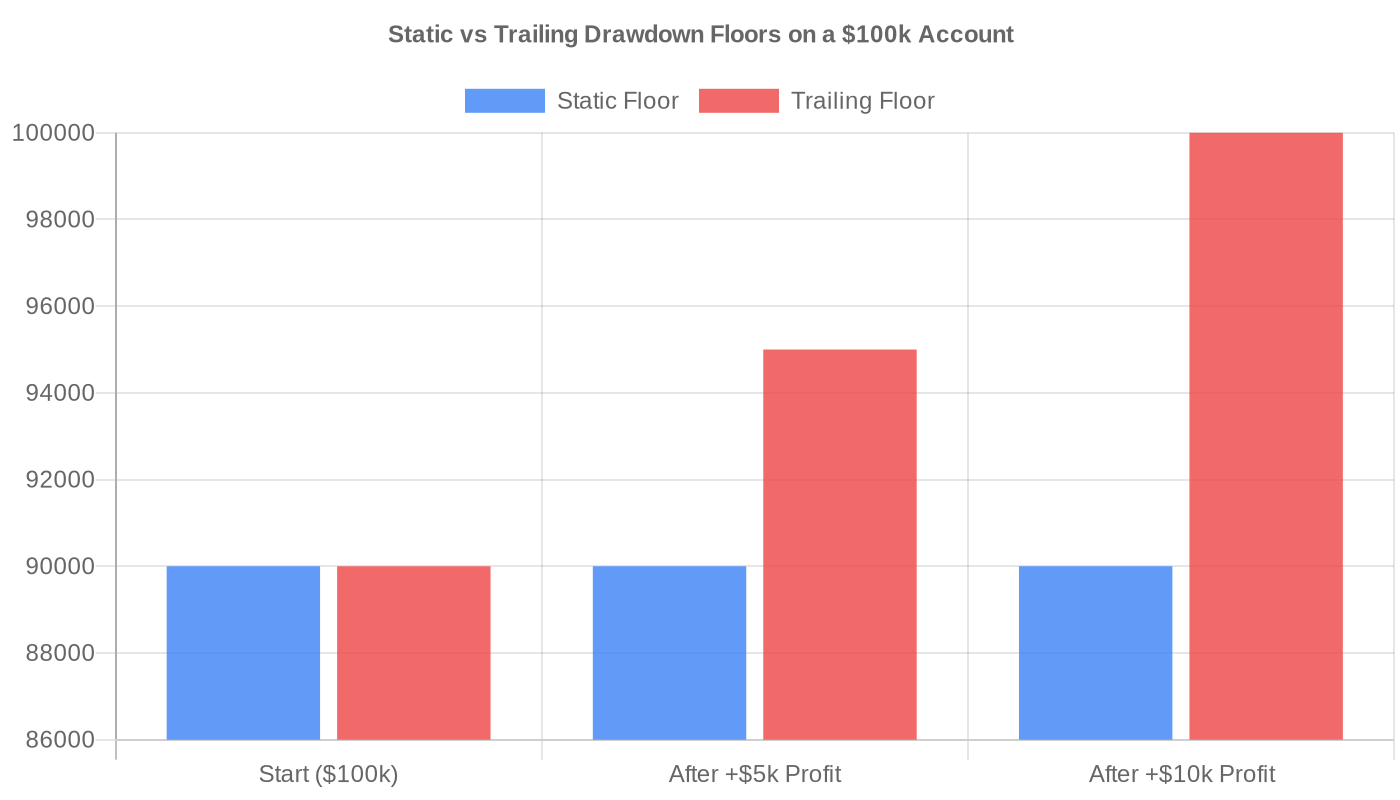
Most firms set maximum drawdown at 8-12% of the initial account balance. A $100,000 account with a 10% maximum drawdown limit cannot drop below $90,000 at any point. Hit that floor and the evaluation ends, regardless of where you started the session.
- Static drawdown is calculated from the initial balance only. If you start at $100,000, your floor stays at $90,000 whether you've made profits or not. It's the more forgiving model.
- Trailing drawdown adjusts upward as your account grows. Start at $100,000, make $5,000, and your trailing floor moves to $95,000 — not $90,000. Topstep's trailing drawdown model works exactly this way, and it's a frequent source of unexpected disqualifications for traders who don't realize the floor moves with them.
The distinction matters practically. Under trailing drawdown, a winning streak can actually shrink your safety margin. You make $8,000, your floor rises to $98,000, and now a $3,000 losing day — which would be fine under static rules — wipes the evaluation.
"Trailing drawdown is the single most misunderstood rule in prop firm evaluations. Traders assume a profitable week gives them more room — it does the opposite. Your cushion shrinks with every gain until you lock in funding." — Merritt Black, Founder of PropFirmMatch and industry analyst
The equity vs. balance distinction adds another wrinkle. Some firms calculate drawdown on balance (closed trades only), which means floating losses don't count until you close the position. Others use equity, which includes your open positions in real time. Equity-based calculation is considerably more restrictive — a large unrealised loss can trigger a breach even if you planned to hold the trade.
How Does the Daily Loss Limit Work?
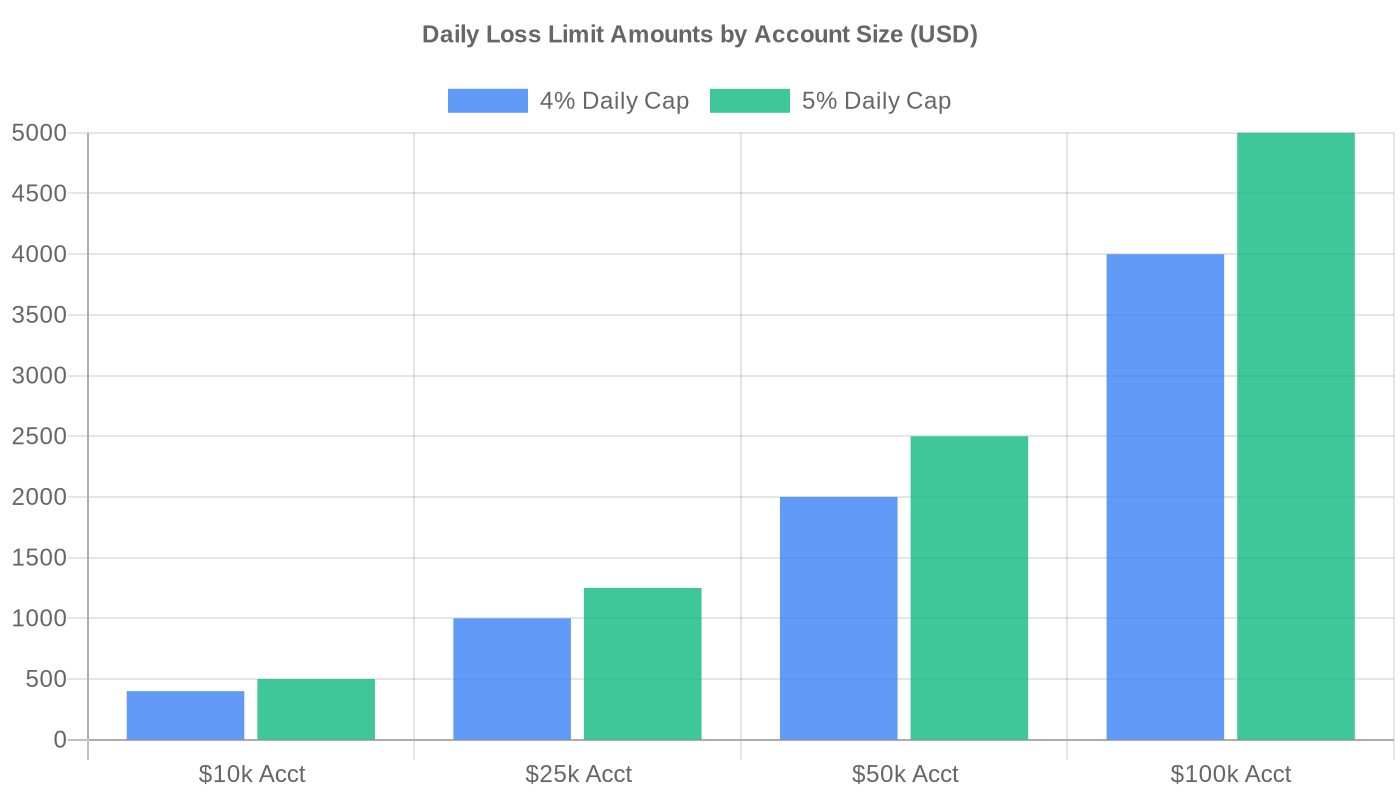
The daily loss limit caps how much you can lose in a single trading day. Across the industry, this sits at 3-5% of the account size. Hit the floor and you're locked out of trading until the next session.
On a $25,000 account with a 4% daily cap, that's $1,000. Three losing trades at 1% risk each — a perfectly reasonable session — and you've used three-quarters of your daily allowance. That constraint is tighter than it initially looks.
I ran a $25,000 evaluation through a two-step challenge. During week two, a bad morning session had me down $780 by noon. Rather than stepping back, I stayed in the market trying to recover. By 2:30pm the loss was $1,050 — past the 4% daily floor. The challenge terminated automatically. My strategy wasn't broken. I just didn't respect the limit when it mattered most. That fee was effectively a lesson in rule discipline.
Like maximum drawdown, daily limits can be calculated on balance or equity. The equity version is stricter — if you're sitting on a losing trade that's approaching the daily limit, you may need to close it before the session ends, even if your thesis is still valid.
What Is the Profit Target Requirement?
Every challenge has a minimum profit target — the percentage gain you need to reach before the firm will advance you to the next phase or approve a funded account. Most two-step evaluations set this at 8-10% for Phase 1 and 5% for Phase 2.
Those percentages sound achievable. In practice, they require sustained, consistent returns within a drawdown envelope that doesn't give you much room for bad weeks. A 10% target on a $50,000 account is $5,000 — while keeping losses below $5,000 total and below $1,500-2,500 per day. That's the challenge.
Some firms add a daily profit cap — typically 20-30% of the total profit target — which limits how much you can bank in a single session. The logic is that one lucky day shouldn't substitute for consistent performance. If your profit target is 8% and you make 4% on Monday, you've hit the daily cap and excess profit may not count. That rule exists specifically to stop traders from taking outsized risks early, getting lucky, and calling it consistent trading.
What Is the Consistency Rule — and Does Every Firm Use It?
The consistency rule caps how much of your total profit target can come from a single day. Common implementations: no single session can account for more than 30-40% of your evaluation profit.
If you need to make 8% total and your daily cap is 30%, no single day can contribute more than 2.4%. That's a meaningful constraint for traders who rely on one or two high-conviction trades per week.
Not all firms apply it. FundingPips removed its consistency rule in recent updates, making it one of the more trader-friendly evaluation environments for those who don't trade every day. FundedNext's CFDs accounts also carry no consistency rule — daily profit distribution isn't evaluated, only drawdown compliance. Their futures legacy accounts apply a 40% guideline, though it's not a hard termination trigger.
The variation matters when choosing a firm. If your strategy generates profits unevenly — a few strong sessions per month with quiet periods between — a strict consistency rule will either force you to trade below your natural frequency or risk breaching the cap on your best days.
Which Trading Strategies Are Banned?
Prop firms ban specific strategies not because they're necessarily unprofitable, but because they're exploitative — designed to extract money from the evaluation structure rather than demonstrate genuine trading skill.
- High-frequency trading (HFT) is universally prohibited. The infrastructure required doesn't exist on evaluation platforms, and the latency arbitrage strategies it relies on have no place in a risk-assessment context.
- Martingale and grid strategies are banned across most firms. Both involve scaling position size after losses to recover drawdown — the mathematical opposite of what prop firms are testing for. A single bad run using Martingale can blow through a 10% maximum drawdown in minutes.
- News scalping — opening and closing positions within a tight window around high-impact news releases — sits in a grey area. Some firms ban it outright. Others, like FundingPips, allow holding trades during news but won't count profits from positions opened or closed within five minutes before or after a scheduled high-impact event. Check the specific policy before your first NFP session.
- Cross-account hedging — simultaneously holding opposing positions on the same instrument across different accounts at the same firm — is prohibited. It's essentially arbitrage against the firm's own infrastructure.
- Expert Advisors (EAs) vary by firm. FundedNext permits EAs, bots, and copy trading "when used responsibly." FTMO allows EAs with restrictions. FundingPips allows automated strategies but not those classified as HFT or tick scalpers. Always verify before running an EA on an evaluation account.
Time Limits and Minimum Trading Days
Most two-step challenges assign a specific window — typically 30 calendar days for Phase 1, 60 for Phase 2 — and require a minimum number of active trading days within that window, usually 5-10.
The minimum trading day requirement prevents a trader from making one massive bet on day one, hitting the profit target, and calling it consistent performance. You need to show up repeatedly. That's the point.
A lesser-known rule: the 30-day inactivity rule applied by some firms (FundingPips included) on funded accounts. If you don't place at least one trade in a 30-day period, the account can be deactivated. It catches traders who go dormant after reaching funded status.
FundedNext stands out here — their CFDs accounts carry no time limit for completing the evaluation. Minimum trading days still apply, but there's no countdown pressure to hit targets by a specific date. That changes how you approach the challenge, especially if your strategy is selective and you prefer waiting for high-probability setups.
What Happens If You Break a Prop Firm Rule?
Breach any hard rule — daily loss limit, maximum drawdown, or a prohibited strategy trigger — and the evaluation terminates immediately. Most firms use automated monitoring that closes positions and locks the account the moment a threshold is crossed. There's no warning, no grace period, no "one more trade."
The evaluation fee is typically non-refundable upon breach. Some firms offer partial exceptions — a percentage refund if you pass Phase 1 but breach Phase 2, for instance — but these are firm-specific and rarely apply to strategy violations.
Account reset options exist at most firms for an additional fee, letting you restart the evaluation without waiting for a new purchase window. Whether that makes financial sense depends on how much of the target you'd already hit.
Only about 14% of traders pass a prop firm challenge on any attempt, and just 7% of all participants ever reach a payout, according to FPFX Tech's analysis of 300,000 accounts (Finance Magnates, March 2025). Most failures aren't strategy failures — they're rule violations during drawdown recovery attempts. That 4pm desperation trade that pushes past the daily limit is the industry's most common termination trigger.
How FundedNext, FTMO, and FundingPips Rules Compare
Rule | FundedNext (CFDs) | FTMO | FundingPips |
Phase 1 profit target | 10% | 10% | 8% |
Phase 2 profit target | 5% | 5% | 5% |
Daily loss limit | 5% | 5% | 4% |
Maximum drawdown | 10% | 10% | 8% |
Drawdown type | Static | Trailing (equity) | Static |
Consistency rule | None (CFDs) | None | Removed (2025) |
News trading | Allowed | Restricted | 5-min rule applies |
EAs/bots | Allowed | Allowed (with limits) | Allowed (no HFT) |
Time limit | None (CFDs) | 30 days Phase 1 | 30 days Phase 1 |
Min trading days | 5 | 10 | 3 |
Max account size | $4M (scaled) | $2M | $200k |
Rule details as of May 2026. Verify against each firm's current terms before purchasing.
For detailed coverage of leading firms, see our top prop trading firms guide.
How to Stay Within Prop Firm Rules While Trading
Knowing the rules isn't enough, you need systems that enforce them before the platform does.
- Set a personal daily loss alert at 70% of your firm's cap. On a $25,000 account with a 4% limit, that's a $700 internal stop. Hit it and you stop trading for the day, full stop. The remaining 30% is a buffer, not an invitation.
- Track your drawdown proximity daily, not just your P&L. A spreadsheet or trading journal showing your current floor versus account equity takes two minutes to update and eliminates the "I didn't realise how close I was" failure mode.
- Size positions so that three consecutive losing trades cannot breach your daily cap. If they can, your lot size is wrong for the evaluation and not your strategy.
The rules don't require perfect trading. They require predictable risk behaviour. Build that into your process before you fund.
The Bottom Line on Prop Firm Challenge Rules
The rules in a prop firm evaluation aren't arbitrary hurdles — they're a risk management test in disguise. Every limit, cap, and restriction is designed to answer one question: can this trader control their downside when conditions turn against them?
Understanding each rule category before you fund an account matters more than your win rate. A trader with a 55% win rate who respects the daily loss limit and stays inside the drawdown envelope will outperform a trader with a 70% win rate who trades to recover every bad session.
For traders exploring prop trading in India or prop trading firms in Canada, the same core rule structure applies across virtually all international evaluation platforms — the numbers may shift slightly, but the framework is consistent.
Start with the maximum drawdown rule and daily loss cap. Know your floors. Know how they're calculated. Know whether the firm uses static or trailing, balance or equity. Everything else — strategy, profit targets, consistency — operates inside those two parameters.
Frequently Asked Questions
What is the difference between daily loss limit and maximum drawdown in a prop firm challenge?
The daily loss limit caps how much you can lose in a single trading session — typically 3-5% of the account. Maximum drawdown limits the total cumulative loss from the account's peak, usually 5-10%. Breaching either terminates the challenge. The daily limit resets each session; the maximum drawdown is cumulative and doesn't reset. Many traders breach the daily limit during recovery attempts after a losing morning.
Can you use Expert Advisors in a prop firm challenge?
It depends on the firm. FundedNext and FundingPips allow EAs, bots, and copy trading when used appropriately — HFT and tick-scalping bots are still banned. FTMO permits automated trading with specific restrictions. Always check the firm's current terms before running any automated system on an evaluation account, as rule changes happen and violations are non-negotiable.
What happens if you break a prop firm rule?
The account terminates automatically. Most firms use real-time monitoring that closes open positions and locks the account the moment a threshold is crossed. The evaluation fee is generally non-refundable upon breach. Some firms offer paid reset options. Strategy violations (hedging, HFT, news scalping within restricted windows) typically result in immediate disqualification regardless of account performance.
Which prop firm has the most flexible challenge rules?
FundedNext's CFD accounts stand out for flexibility: no consistency rule, no time limit to complete the evaluation, and news trading is allowed. FundingPips removed its consistency rule in 2025 and offers static drawdown, which is more forgiving than trailing drawdown. "Flexible" depends on your trading style — a trader who holds overnight positions needs different rule sets than a day trader who closes everything before market close.
How long does a typical prop firm challenge take to complete?
Most two-step challenges allow 30 calendar days for Phase 1 and 60 for Phase 2, with minimum trading day requirements of 5-10 active sessions per phase. Some traders complete Phase 1 in two weeks. Others use the full window. FundedNext's CFD accounts have no time limit, which suits lower-frequency strategies. The minimum trading days requirement means you can't rush through on a single massive bet — consistency is the measured variable.