How to Pass Prop Firm Challenge: Complete Strategy Guide
Discover the key rules, risk management techniques, and trading habits that help traders solve the question on how to pass prop firm challenges and get funded.

The challenge fee is paid. The account is live — simulated capital, real rules. You've got a 10% profit target, a 5% daily loss limit, and somewhere between 30 and 60 days to get there.
Most traders don't.
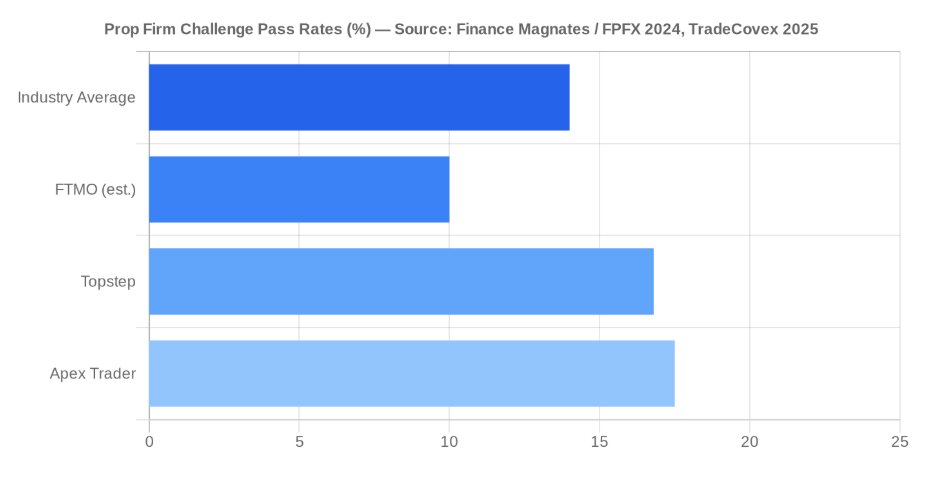
An FPFX Technology study of more than 300,000 accounts across 10 prop firms found that just 14% of traders pass the evaluation phase — and only 7% ever receive an actual payout (Finance Magnates, 2025). That's not a rumor or a pessimistic estimate. That's 300,000 accounts of data.
This guide covers the specific rules, risk structures, and behavioral patterns that separate the 14% from everyone else and helps you to crack how to pass prop firm challenge.
Passing a prop firm challenge comes down to strict rule compliance, per-trade risk limits below 2%, and consistent execution over multiple trading days. Just 14% of traders pass the evaluation and only 7% receive a payout — so preparation and discipline, not raw trading skill, determine most outcomes. Start by mastering the rules. The rest follows.
What Is a Prop Firm Challenge?
A prop firm challenge is an evaluation that determines whether a trading firm will fund you with real capital. You trade a simulated account under live market conditions, and if you hit a profit target without breaching drawdown or rule limits, you get access to a funded account — typically with a 70–90% profit split.
The global prop trading industry crossed $20 billion in market size in 2024, with interest in prop firms growing 607% between 2020 and 2024 (QuantVPS, 2026). That growth attracted both serious traders and a wave of people who bought a challenge without understanding what they were actually signing up for.
The challenge isn't just a profitability test. It's a rules compliance test. Firms want to know you won't blow their funded accounts, which means your ability to stay within drawdown limits matters as much as hitting the profit target — sometimes more.
Most challenges run in two phases. Phase 1 has the higher profit target (typically 8–10%). Phase 2 is a verification stage with a lower target (4–5%), confirming the Phase 1 result wasn't a lucky streak. Pass both, and you're funded.

Why Most Traders Fail the ‘How to pass Prop Firm Challenge’ segment (And What the Data Shows)
The 14% pass rate isn't a mystery. The failure modes repeat.
FundedNext's analysis puts the top culprits in order: violating the daily drawdown limit, breaking the maximum drawdown rule, and abandoning the trading plan under pressure. These aren't skill failures — they're discipline failures. A trader who knows how to read price action still blows the challenge by sizing up on a "perfect" setup, hitting a run of losses, and then revenge trading to recover.
The data backs this. Traders who receive actual payouts — that 7% figure from the FPFX study — share a consistent profile: they risk small per trade, they don't deviate from their strategy under pressure, and they treat missing a trading day as preferable to forcing a bad trade.
What the 86% who fail look like in practice:
- They calculate the daily profit needed to hit the target and size trades to that number rather than their risk tolerance
- They see the daily drawdown limit as a floor, not a warning line
- They overtrade on slow days out of boredom or anxiety
- They let one bad trade turn into a session-destroying spiral
The challenge isn't designed to be unfair. It's designed to filter for the behaviors that keep funded accounts profitable. Understanding that reframes the whole exercise.
Know the Rules Before You Risk a Single Position
Read the challenge rulebook. All of it. Before you open a chart.
Every failed challenge starts the same way — with a trader who had a rough idea of the rules but didn't understand exactly where the lines were. That's the difference between a 4.9% daily loss on a $100,000 account (fine) and a 5.1% daily loss (account failed, challenge over).
Profit Target
Most firms set Phase 1 at 8–10% of starting capital. FTMO's standard challenge requires 10%. Phase 2 targets drop to 4–5%. These percentages sound modest until you run the math against the drawdown limits.
On a $100,000 account with a 10% profit target, you need $10,000 in net gains. With a 5% daily loss limit, a single bad day costs you $5,000 — half your target in losses you now have to overcome. That asymmetry is why traders who think "I just need to average $500/day" almost always fail.
Daily Drawdown Limit
The daily limit is usually 3–5% of the starting account balance. FTMO uses 5% for most challenge types. The critical detail most traders miss: many firms calculate daily drawdown from the highest equity point of that day, not the opening balance. Reach a $103,000 equity peak at 10am, and your drawdown limit for that day shifts accordingly.
Miss this distinction and you'll blow an account thinking you had $5,000 of buffer when you actually had $2,000.
Maximum Drawdown Limit
The overall drawdown cap sits at 8–12% across most firms, with 10% being the standard. Some firms use a static drawdown (always calculated from the original starting balance). Others use trailing drawdown that adjusts with your peak equity. Trailing drawdown is more aggressive — it means your maximum drawdown limit gets tighter as you profit.
Check which model applies before you trade.
Minimum Trading Days
Most challenges require 4–30 minimum trading days. This prevents traders from getting lucky in a handful of aggressive sessions. You can't hit the profit target in three days and call it done. The consistency requirement is built into the structure.
How to Structure Your Risk to Last the Evaluation
The math is straightforward. Getting traders to actually follow it is the hard part.
Per-trade risk on a prop firm challenge should sit between 0.5% and 2% of the account balance. For a $100,000 account, that's $500 to $2,000 maximum risk per trade. Most traders who pass consistently run 0.5–1%.
Here's why that matters for surviving the evaluation:
At 1% risk per trade, you'd need 10 consecutive losing trades to hit a 10% drawdown. That's statistically rare if your strategy has a positive expectancy. At 3% risk per trade, three losing trades in a row puts you at 9% drawdown — one more bad trade and you're out.
The mental challenge is that 0.5–1% risk feels boring when you're watching a "perfect" setup form. It feels like you're leaving money on the table. But the traders in that 7% payout group — they're not the ones who ran 5% risk on high-conviction trades. They're the ones who ran 1% consistently across 40+ trades and let the math work.
Calculate your maximum daily loss scenario before each session. If you've already lost 2% today, your remaining buffer before the 5% daily limit is 3%. At 1% risk per trade, you have three more trades. That number should determine whether you keep trading or call the session done.
Protect the downside. The upside handles itself.
Does Your Strategy Actually Have an Edge?

I've looked at a lot of challenge breakdowns in trading communities. The accounts that fail fastest aren't the ones with bad strategies — they're the accounts with untested strategies. Traders who bought the challenge as motivation to "finally get serious" and expected the pressure to produce discipline.
It doesn't work that way. Pressure amplifies whatever patterns you already have.
Before running any prop firm challenge, your strategy should have at minimum 6–12 months of backtested results on historical data — and ideally 2–3 months of forward testing on a demo or small live account. FundedNext's own guidance pushes the 6–12 month backtesting window as baseline. That's not excessive. A strategy without that sample size doesn't have a statistically meaningful edge — it has a lucky run.
The backtesting should tell you your actual win rate, your average risk-reward, your maximum consecutive losing streak, and your typical drawdown profile. If your strategy has a maximum 8-trade losing streak in backtest, you know that a 4-trade losing streak in your challenge isn't a reason to abandon the approach — it's within the expected range. That knowledge is what keeps you from revenge trading.
What the backtest needs to prove:
- Win rate above 45% with a risk-reward ratio of at least 1:2 (or higher win rate with 1:1 RR)
- Maximum drawdown in backtest below the challenge's maximum drawdown limit
- At least 100 trade sample size for statistical relevance
If the numbers aren't there on paper, they won't be there in the challenge.
Consistency Over Heroics — The Pattern That Gets Funded
Topstep reports a 16.8% pass rate for its evaluation in 2025 — the highest publicly disclosed rate among major prop firms (TradeCovex, 2025). That still means 83.2% of traders fail.
The common thread in the accounts of traders who pass: they aim for boring consistency, not spectacular days.
What consistency looks like in practice:
Target 0.5–1% account growth per day, not the total profit target divided by trading days. If you need 10% in 30 days, that's 0.33%/day — well below what you'll make on a good day, which leaves buffer for bad days. Most traders who chase the "daily average" end up either overtrading on slow days or sizing up to compensate for slow sessions.
Stick to your predefined setup criteria. If your strategy only triggers on a specific candlestick pattern at a specific session time, don't trade outside those conditions because you're behind on the target. You're not being disciplined — you're being impatient. Those are different things.
Count your minimum trading days early. If the challenge requires 10 minimum trading days and you're on day 3, you have flexibility. Use it. Not every day needs a trade. Waiting out a ranging market that doesn't suit your style is a decision, not a failure.
The Psychological Traps That Kill Challenges in the Final Days
The pattern shows up repeatedly in challenge post-mortems: accounts that fail don't fail at the start. They fail in the final third.
A trader gets to day 25 of a 30-day challenge. They're at 7.5% profit against a 10% target. They need 2.5% more in 5 days. The math looks easy. The pressure isn't.
Those last days produce the worst decisions:
- Revenge trading after a loss. One losing trade erases a day's gains. The trader immediately jumps back in to "get it back" — at a bigger size, with a worse setup, in the wrong market conditions. That trade usually produces another loss. Now they're at 5% profit with 3 days left and still trading emotionally.
- Chasing the target. "I just need one big trade." This kills more challenges than any market condition. The trader starts taking setups they wouldn't normally touch, sizing up beyond their normal risk parameters, and forcing trades in the wrong session or on the wrong pair. One reckless trade doesn't just fail the day — it can breach the maximum drawdown and end the challenge entirely.
- Letting up after a great run. The opposite problem. A trader is at 9.8% profit with 10 days left. They need 0.2% more. Instead of executing their normal strategy, they get cautious — avoiding trades, hesitating on clear setups, waiting for "perfect" conditions that don't exist. The anxiety of protecting the gain leads them to miss three straightforward entries. They're still at 9.8% with 3 days left, now forcing the issue.
The solution for all three: predecide what a bad day looks like. "If I lose 2% today, I stop trading for the session." "If I hit the daily limit, I walk away." Not as a vague intention. Written in the trading log before the session starts.
Prop Firm Challenge Rules — Quick Reference

The parameters below reflect industry-standard ranges. Verify exact figures with your specific firm before trading.
Parameter | Typical Range | FTMO Standard | What to Check |
Phase 1 Profit Target | 8–10% | 10% | Static % or trailing? |
Phase 2 Profit Target | 4–5% | 5% | Same account balance baseline? |
Daily Drawdown Limit | 3–5% | 5% | Balance-based or equity peak? |
Max Drawdown Limit | 8–12% | 10% | Static or trailing? |
Min Trading Days | 4–30 | 10 | Days with open positions count? |
Time Limit | 30–60 days | No limit (FTMO) | Hard cutoff or rolling? |
Profit Split (Funded) | 70–90% | 80% | Scaling plan available? |
The two columns that matter most: "Daily Drawdown Limit" and "Max Drawdown Limit." Know whether your firm uses a static drawdown (always referenced from starting balance) or trailing drawdown (adjusts to your peak equity). This changes your actual risk buffer significantly.
The Bottom Line on Passing Prop Firm Challenges
Passing a prop firm challenge comes down to one thing: treating the evaluation as a rules compliance test, not just a profitability test. With only 14% of traders clearing the evaluation phase and 7% receiving payouts, the decisive factor isn't raw trading ability — it's the combination of verified strategy, strict risk limits, and discipline under pressure across every trading day.
Know your rules before you trade. Set per-trade risk below 2%. Backtest your strategy for at least 6 months before starting. Trade consistently, not heroically. And make your stop-for-the-day decisions before the session starts, not after a bad trade.
The challenge isn't designed to be impossible. It's designed to filter for traders who won't blow a funded account. Prove you're one of them.
Ready to compare which prop firms are worth the fee? Browse our prop firm reviews to see current challenge terms, payout track records, and rule structures across the major platforms.
Frequently Asked Questions
What is the success rate of prop firm challenges?
According to an FPFX Technology analysis of 300,000+ accounts across 10 prop firms, approximately 14% of traders pass the challenge phase — and only 7% ever receive a payout (Finance Magnates, 2025). Pass rates vary by firm: Topstep reported 16.8% in 2025, while FTMO estimates run closer to 10%.
How much risk should I take per trade on a prop firm challenge?
Keep per-trade risk between 0.5% and 1% of account balance throughout the evaluation. At 1% risk, you need 10 consecutive losses to hit a 10% maximum drawdown — statistically rare with a tested strategy. Higher risk per trade shrinks your error margin and makes a single bad session account-ending.
Can I use an EA or automated strategy on a prop firm challenge?
Most prop firms permit automated trading strategies, but rules vary. Some prohibit high-frequency trading, latency arbitrage, or grid/martingale strategies that exploit the demo account pricing environment. Check the specific firm's prohibited trading practices before running any EA. Using a banned technique is an instant disqualification — usually without a refund.
How long does a prop firm challenge take to complete?
Most challenges have a 30–60 day window, though some firms like FTMO operate with no time limit. The real constraint is minimum trading days — typically 4 to 30 days with open positions. Most traders who pass do so within 3–6 weeks. Rushing to finish before the minimum days are met is a common mistake that forces bad trades.
What happens if I fail a prop firm challenge?
The challenge fee is forfeit. Some firms offer a free retry or a reset at a reduced cost if you fail due to hitting the maximum drawdown limit rather than a rule violation. A few offer discounts on repurchases. If your account was closed for breaking a specific rule — trading during news events on a restricted account, using a prohibited strategy, or violating the consistency rule — check whether refund eligibility applies before repurchasing.