Forex Risk Management: A Guide to Protecting Your Account
Key Takeaways
- Risk a small, fixed share of your account on each trade, often 1% to 2%.
- Choose your stop first, size the trade from it, and check that the reward justifies the risk.
- Leverage changes the margin you need, but your position size decides your risk.
- A stop loss can close a trade at a worse price than you set, so leave room for gaps.
- Daily and overall loss limits protect the account when several trades go wrong.
Forex risk management is the set of rules that caps how much you can lose on one trade, in one day, and across your whole account. It comes down to a few choices: how much to risk per trade, where to exit if you are wrong, how large to trade, how much leverage to use, and when to stop for the day. Leverage is the buying power your broker lends you.
This guide explains each choice in plain steps. It uses one USD 10,000 example account throughout and ends with a checklist to run before every trade.
Why Risk Management in Forex Trading Comes First
Risk management in forex trading comes first because you control the size of your losses but not the market. Every strategy has losing trades, so the size of each loss decides whether the account survives a bad run.
In a 2018 consultation report, IOSCO, the global body of securities regulators, said several of its members found “a majority of clients lose money on these products,” meaning leveraged products such as forex and CFDs, which are contracts that track an asset’s price. Rules set before you trade limit how much each loss can cost.
How Much to Risk Per Trade
Risk per trade is the amount you lose if your stop is hit. It is shown as a share of your account. CMC Markets, a forex broker, suggests risk per trade can be 1% to 2% of your account, with 0.5% for cautious traders and up to 5% for aggressive ones.
On our USD 10,000 example account, the share you pick changes how a losing run feels:
| RISK PER TRADE | LOSS AT THE STOP | ACCOUNT AFTER TEN LOSSES IN A ROW |
|---|---|---|
| 1% | USD 100 | About USD 9,040 (down 9.6%) |
| 2% | USD 200 | About USD 8,170 (down 18.3%) |
| 5% | USD 500 | About USD 5,990 (down 40.1%) |
Each loss is taken from the balance left after the one before.
Small shares matter because losses are tougher to recover than they look. A drawdown, which is a fall from your highest balance, of 20% needs a 25% gain to recover, and a drawdown of 50% needs 100%. If you are new, the low end of the range keeps early mistakes affordable.
Place a Stop Loss on Every Trade
A stop loss is an order that closes a trade at a set price to cap your loss. Place it where your trade idea is proven wrong, not where the loss feels comfortable.
Traders place stops in three common ways:
- Technical level: Just beyond a recent high or low, such as under the last swing low, the recent low point before price turned up, on a buy.
- Volatility: A multiple of the Average True Range (ATR), which measures how far price usually moves in a period.
- Fixed percentage: A set distance based on a percentage of price.
A stop loss does not guarantee your exit price. In fast markets or after a weekend gap, a stop can fill at a worse price, which is called slippage. A guaranteed stop closes at the price you set, but IG, a broker, notes that a premium is charged if it triggers, and not every broker offers one. Leave room for this by risking a little less than your limit, as the loss limits section shows.
Size Each Trade From Your Stop
Forex position sizing turns your risk per trade and your stop into one number: how many lots to trade. A lot is 100,000 units of the base currency, the first currency in a pair.
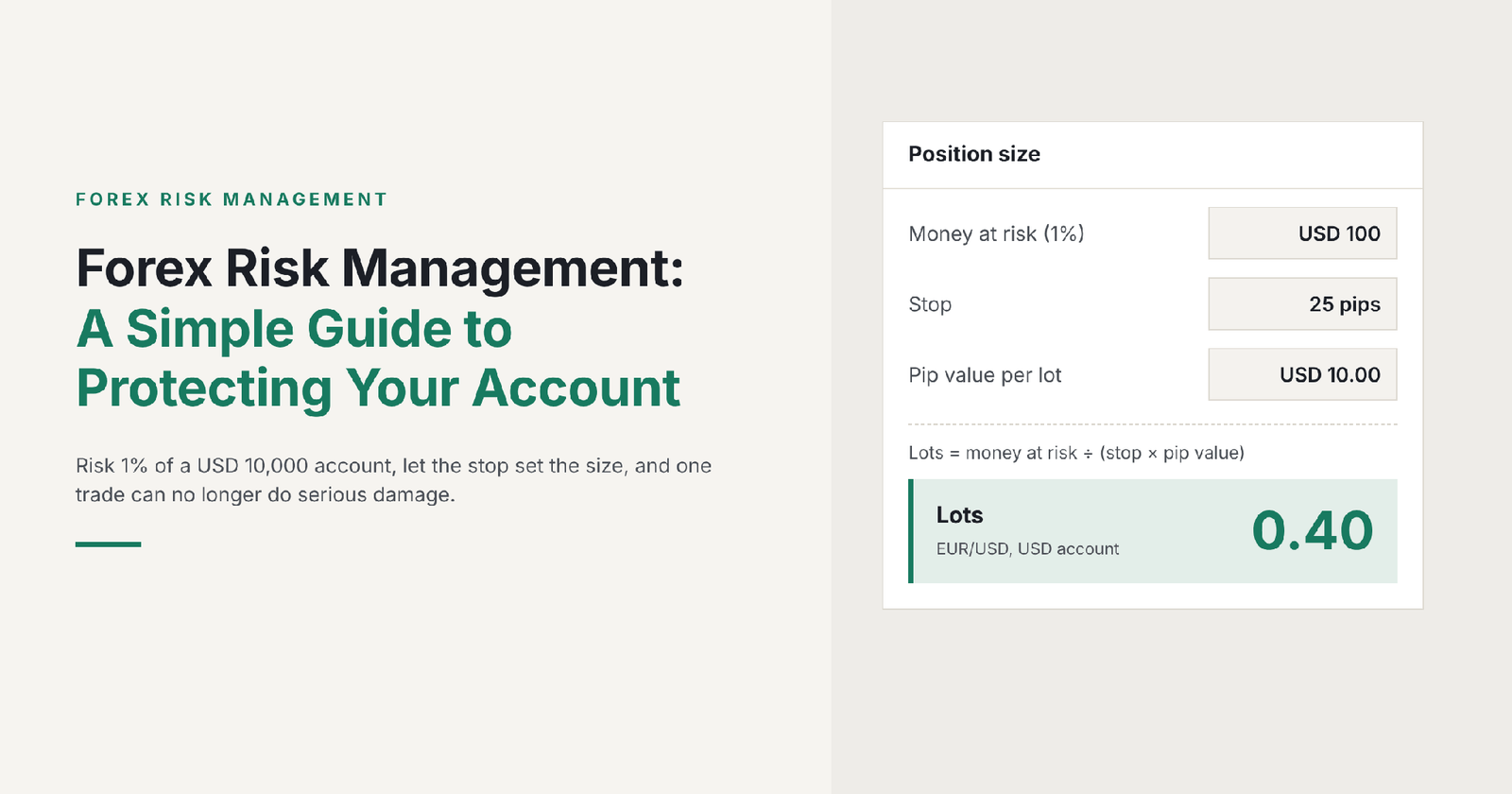
The formula is lots = money at risk ÷ (stop in pips × pip value per lot). A pip is the usual smallest price step, 0.0001 on most pairs. Pip value is what one pip is worth for one lot, which is USD 10 on EUR/USD for a USD account. Here is our example, risking 1% with a 25-pip stop:
- Money at risk: 1% of USD 10,000 is USD 100.
- Stop distance: 25 pips.
- Pip value: USD 10 per lot.
- Position size: 100 ÷ (25 × 10) = 0.40 lots.
A wider stop means a smaller position, because the risk stays fixed. With a 50-pip stop, the same trade is 0.20 lots. Round down to your broker’s smallest lot step, or use a lot size calculator to do the sums. Our forex trading glossary defines the related terminology in more detail.
How Leverage Affects Your Risk
If you size the trade from your stop, leverage does not change your loss at the stop. It changes the margin, which is the deposit your broker holds while the trade is open. We ran the 0.40-lot trade above at three leverage levels:
| LEVERAGE | MARGIN HELD FOR 0.40 LOTS OF EUR/USD (PRICE 1.1000) | LOSS IF THE STOP IS HIT |
|---|---|---|
| 1:30 | USD 1,467 | USD 100 |
| 1:100 | USD 440 | USD 100 |
| 1:500 | USD 88 | USD 100 |
Margin = lots × 100,000 × price ÷ leverage.
The loss stayed at USD 100 every time, and only the margin changed. Leverage becomes dangerous when it lets you trade bigger than your stop allows. At 1:500, you could open 5 lots with about USD 1,100 of margin, and a 25-pip loss would then cost USD 1,250, or 12.5% of the account.
See the leverage on offer as a ceiling, not a target. Limits differ by country, and UK retail accounts, for example, face a 30:1 cap on major pairs. Brokers also set their own margin terms, so check the forex broker conditions before you trade.
Check Reward Against Risk
The risk-reward ratio compares what you aim to gain with what you risk. A 1:2 ratio means aiming to make twice the amount you risk. Check it before you place the trade, since it tells you whether the setup is worth taking.
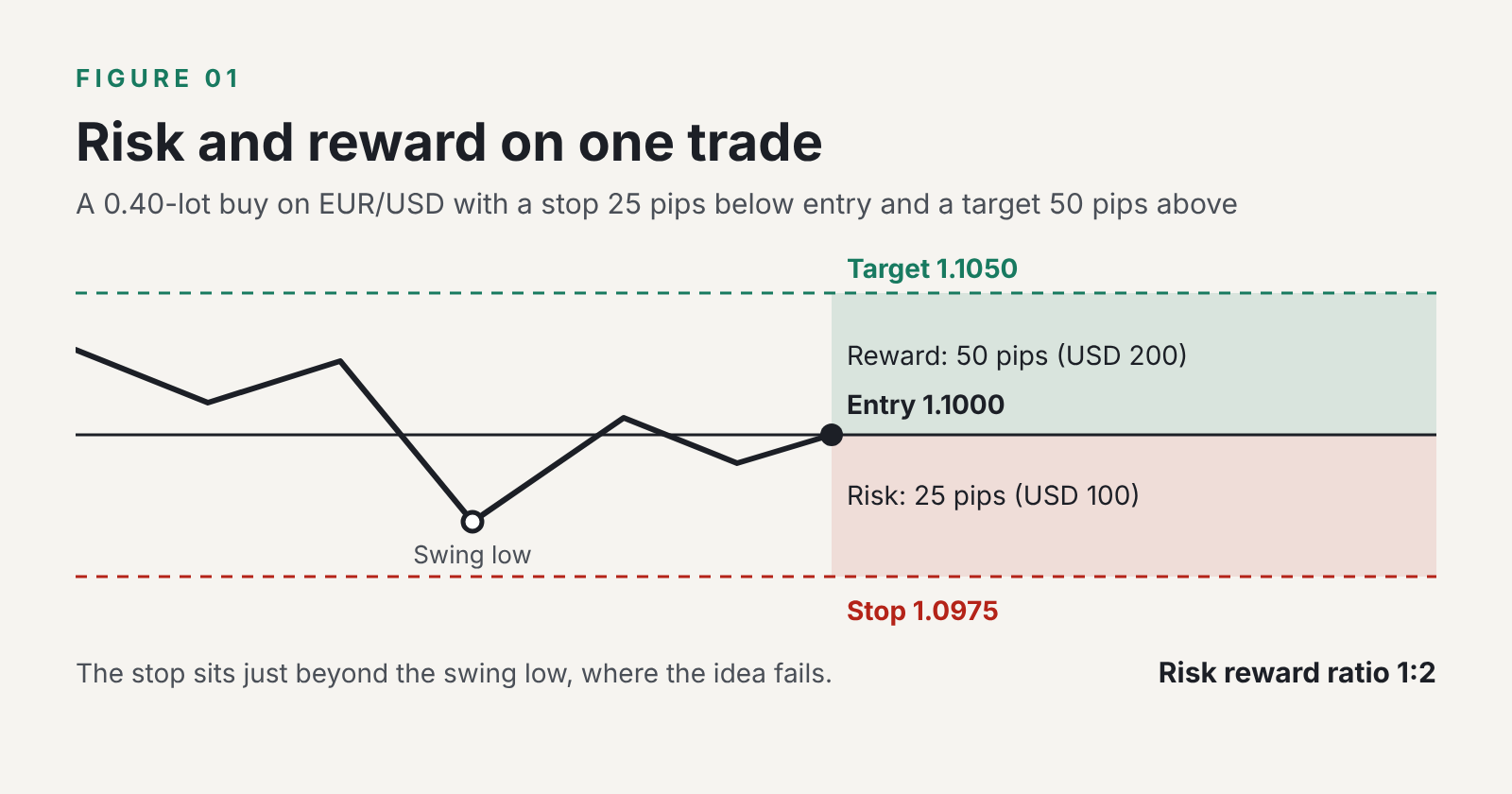
Figure 01. A buy with its stop below the swing low and its target twice as far above entry, a 1:2 risk-reward ratio.
The ratio also sets how often you must win to break even before trading costs. At 1:1 you need to win half your trades, at 1:2 about one in three, and at 1:3 one in four. A higher ratio gives you more room to be wrong, but only when the target is realistic for the market you trade.
Set Daily and Account Loss Limits, Especially on a Funded Account
A daily loss limit is the most you allow yourself to lose in one day. When you reach it, you stop trading until the next day.
Funded accounts, which a prop trading firm lets you trade after you pass its test, enforce a limit for you. FTMO, a prop firm, sets it at 3% or 5% of the account depending on the account type, and it counts open trades because it is measured on equity, which is your balance plus or minus the profit or loss on open trades. It also sets an overall Max Loss of 10%. Rules differ by firm, so read the prop firm rules first.
To fit the limit, divide it by the number of losing trades you can afford in a day, then risk a little less. With a 3% limit and room for three stops, risking 0.75% on each leaves a buffer for slippage.
Set an account-level limit of your own too, such as a weekly loss or a maximum drawdown at which you pause and review. Count related trades together. EUR/USD and GBP/USD often move together, so two 1% trades can act like one 2% trade. Portfolio management in forex shows how to spread risk across pairs.
Your Forex Risk Management Pre-Trade Checklist
Strong forex risk management strategies come from one routine repeated before every trade, not from any single rule. Work through these checks in order:
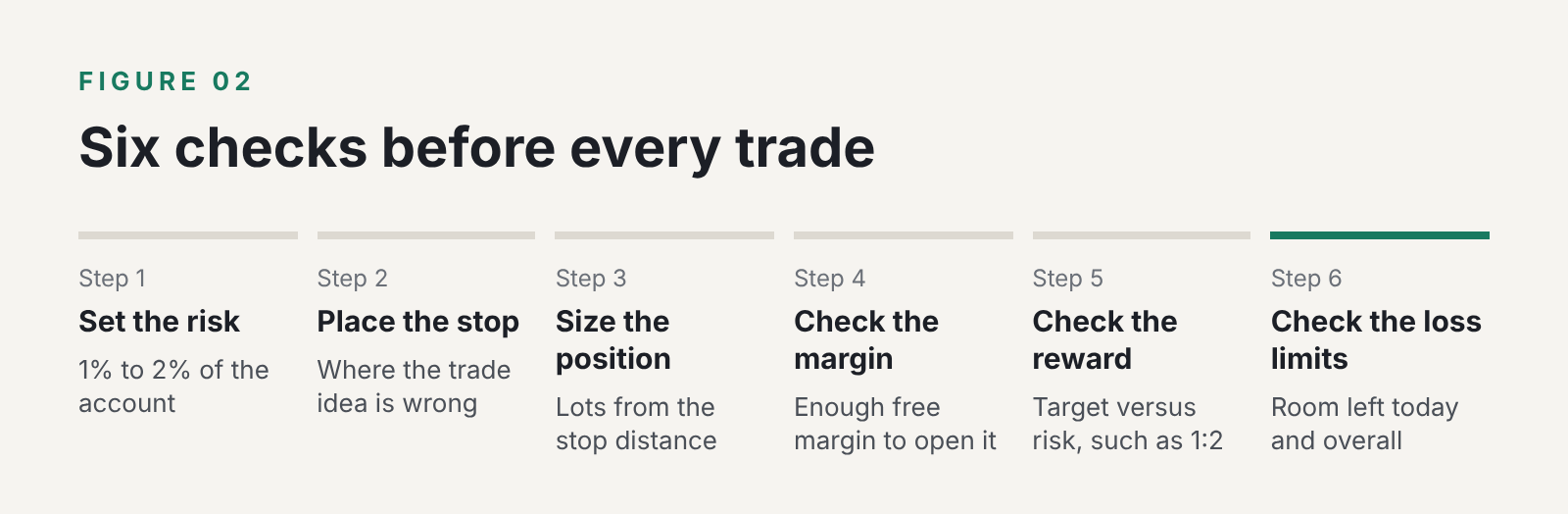
Figure 02. The pre-trade checklist, in order.
Run it every time, and no single trade can do serious damage to the account, although gaps and slippage can still cost more than planned.
Frequently Asked Questions
What is a good risk per trade in forex?
A common guideline, cited by CMC Markets, is 1% to 2% of your account on each trade, and some traders use as little as 0.5%. On a USD 10,000 account, 1% is USD 100. The lower end suits beginners because it keeps a losing run affordable.
How do I calculate position size in forex?
Divide the money you will risk by your stop in pips times the pip value per lot. Risking USD 100 with a 25-pip stop on EUR/USD, where one pip is worth USD 10 per lot, gives 0.40 lots. Round down to your broker’s lot step.
Does leverage increase risk in forex?
Leverage raises risk only when it lets you open a bigger position than your stop allows. If you size each trade from your stop, the loss at the stop stays the same at any leverage. Higher leverage mainly lowers the margin your broker holds.
Does a stop loss always limit my loss?
No. A normal stop loss can fill at a worse price in fast markets or after a weekend gap, which is called slippage. A guaranteed stop closes at your set price, but brokers charge a premium when it triggers, and not every broker offers one.
What is a daily loss limit on a funded account?
It is the most equity a funded account may lose in one day, set by the prop firm. FTMO’s 2-Step account uses 5% and measures it on equity, so open trades count. Breaking the limit can end the account, so check your firm’s rules.
RISK WARNING
Risk disclaimer: Forex and CFD trading with leverage carries a high risk of losing money rapidly, and prop trading also risks the loss of evaluation fees. This guide is educational and is not financial advice.