Is Prop Trading Legal in India? What SEBI, RBI and Tax Rules Say
Key Takeaways
- Skip any firm on the Reserve Bank of India’s unauthorized forex list, and never read a missing name as approval.
- Find out which company you contract with and whose law rules, before you pay.
- Price each fee with bank charges and tax, and set a yearly fee cap, since a fee may be lost.
- Make sure payouts reach an account in your name, and keep every record for your CA or tax professional.
NOT TAX ADVICE
This article is for informational purposes only. Tax laws vary by jurisdiction. Consult a qualified tax professional for advice specific to your situation.
The regulator texts and reports read for this article give no single yes or no on whether prop trading is legal in India. Even FundedFast, itself a prop firm, says on a page it last reviewed on 5 October 2026 that no source it cites gives one. So judge “legal” for your own case, from what SEBI (the Securities and Exchange Board of India, the market regulator) and the RBI (the Reserve Bank of India) have said and from the firm’s own terms. Then work out what the fee costs, and hand the tax questions to your CA, a chartered accountant or other tax professional.
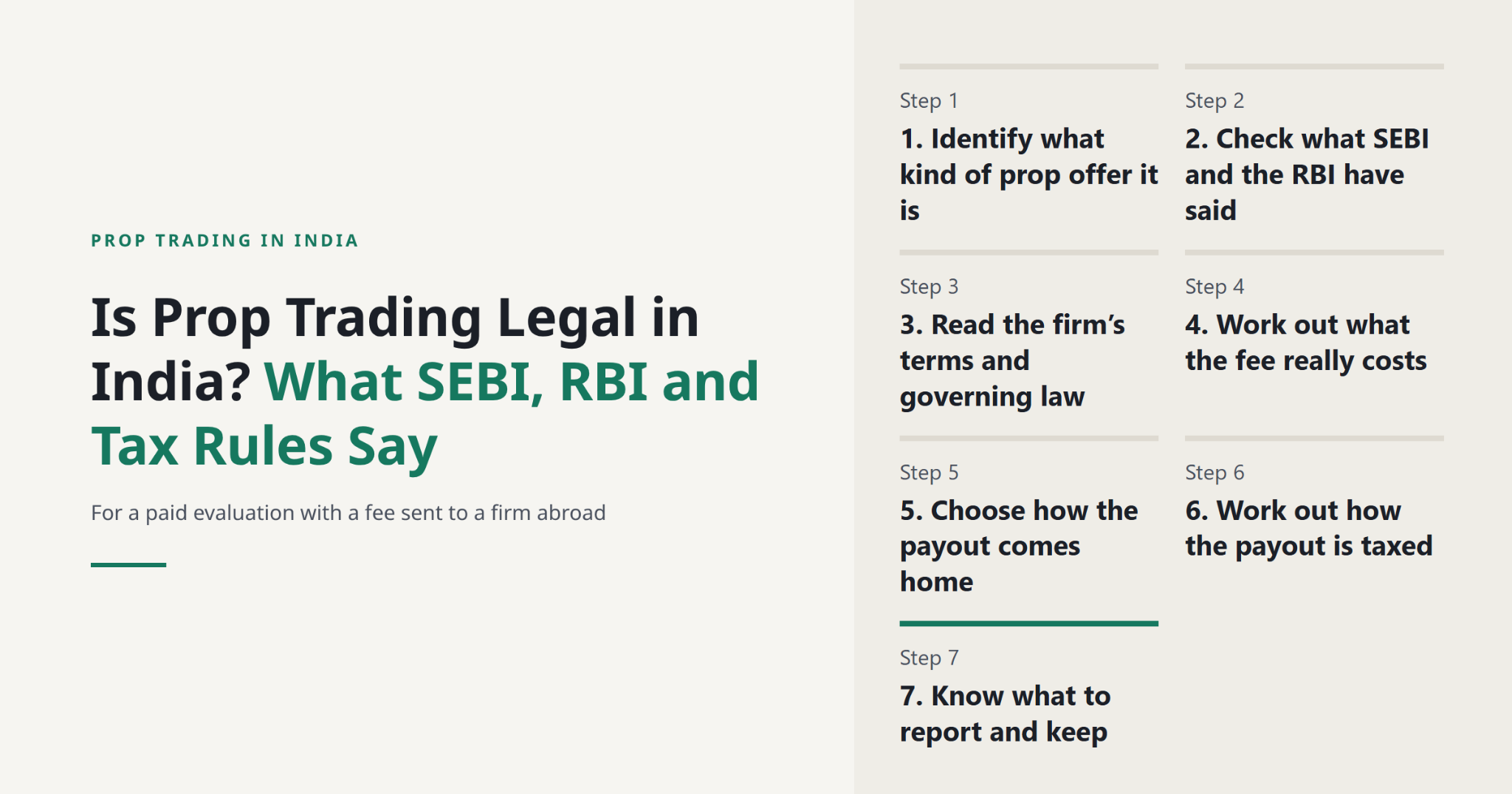
This article covers one model: a paid evaluation, with the fee sent to a firm abroad. Steps 1 to 5 are checks you run yourself, and steps 6 and 7 are hand-offs to your CA. Each step is shown on Meera, a trader made up for this article: an Indian resident with a salary, who files with a CA and is weighing her first paid evaluation.
1. Identify what kind of prop offer it is
“Prop firm” names two businesses. An institutional proprietary trading firm hires traders to trade its own money. A retail prop firm sells you a paid evaluation. Pass it, and you trade a funded account: the firm’s capital, without any deposit of yours in it. Most offers fit one of three kinds:
- If it takes a deposit of your own money to trade, or charges you to trade on someone’s terminal in India, treat it as a red flag and walk away (Zerodha’s view, below).
- If you pay nothing and a firm trading its own money hires you, steps 2 to 5 don’t apply.
- If you pay a fixed fee to a firm abroad for an evaluation account and a profit share, go on to step 2.
A fixed fee to a firm based in India fits none of the three. No source read covers it, so treat it as a red flag and take advice before paying.
Meera has three offers. The local desk wants a deposit before she trades on its terminal, so she walks away. Her two overseas offers sell an evaluation for a fixed fee and a profit share, so both go to step 2.
Zerodha’s In The Money (8 December 2025) says a real prop firm hires you, and that the moment a firm asks for your money, it’s almost certainly a scam or an illegal sub-broker setup. Its example is a Surat case, where terminals meant only for a broker’s own money were opened to outsiders for deposits, commissions, and profit shares.
These are Zerodha’s views of Indian set-ups, with no law cited. It names no overseas evaluation firm, so for an overseas evaluation fee, go on to steps 2 and 3, which can rule a firm out but clear nothing alone.
2. Check what SEBI and the RBI have said
Before you pay, search the firm’s name and website on the RBI Alert List, the RBI’s published list of unauthorized forex trading platforms. Find it on the RBI’s own website. If the firm is listed, don’t pay it. If it isn’t, the firm is still uncleared, so go on to step 3. Skipping a listed firm is a precaution, not a legal finding about your case.
Meera searches both overseas firms. Her first choice is on the list, so she drops it. Her second isn’t, which leaves it uncleared, so she opens its terms.
Outlook Money, carrying a PTI report, says the RBI added seven names to its Alert List of unauthorised forex trading platforms on 19 November 2025, taking it to 95, including FTMO, Smart Prop Trader and FundedNext. This is a news copy, not the RBI’s own page, and it misses later updates. As reported, the RBI says listed entities are not authorized to deal in forex under FEMA (the Foreign Exchange Management Act, 1999), and that “an entity not appearing in the list should not be assumed to be authorised by the RBI.”
Khaitan & Co, a law firm, describes SEBI’s 4 November 2024 advisory in its own note as cautioning investors against unauthorized platforms offering virtual trading, paper trading or fantasy games based on real-time stock price data. The note doesn’t mention prop firms, and SEBI’s own text was not read, so don’t take the advisory as either a ban or a clearance.
The RBI Alert List is the one list to search, as no source read gives a SEBI one. None of these texts says it covers a resident paying a fixed fee for an evaluation, so the list can rule a firm out and nothing here rules one in.
3. Read the firm’s eligibility and governing-law terms
Open the firm’s terms and find its restricted-country list, the company you contract with, and the governing law and courts (whose law rules the contract, and where a dispute goes). If the list names India, don’t pay. Otherwise, write down the company and the law. If the terms name no company for the account you trade (The5ers’ row below), ask the firm in writing which one before you pay. Treat every fee as money you may not get back. For the evaluation’s own trading rules, see the prop firm challenge rules.
India isn’t on her second firm’s list. Meera writes its contracting company and governing law into a dated records file, and takes the fee to step 4.
Here are those clauses in FundedNext’s terms of service and The5ers’ terms and conditions. FundedNext is on the Alert List copy above, so step 2 would stop you there. It appears only to show what to look for.
THE CLAUSE | FUNDEDNEXT (TERMS UNDATED, READ 22 OCTOBER 2026) | THE5ERS (TERMS UPDATED 20 OCTOBER 2026) |
Who you contract with | GrowthNext F.Z.E., Ajman Free Zone, UAE, the sole contracting party | Names FIVE PERCENT ONLINE LTD (England and Wales, and Israel) as website operator; states no contracting party for the account you trade |
Governing law and courts | Laws of the Emirate of Ajman and UAE federal law, save mandatory consumer-protection rules that cannot be derogated from | Israeli law, exclusive jurisdiction of Israeli courts, all subject to the applicable law |
India on the restricted list | Not named in the CFD list “at the time of publication” | Not named in a list “including but not limited to” |
Can the firm still refuse you? | Yes, clause 5.5 | Yes, at its sole discretion |
India’s absence from a list gives no permission. FundedNext’s clause 5.5 lets it block anyone, and The5ers’ list is open-ended. FundedNext’s terms also make you undertake “to verify in advance whether access to and use of the Services is permitted” where you live.
Recourse is thin too. Khaitan & Co reads SEBI’s 2024 release as saying investors using unregistered intermediaries, such as the virtual trading platforms its note covers, have no recourse with SEBI, including through SCORES, its complaints system. As step 2 says, the note doesn’t mention prop firms, so whether that route is open to you is unclear.
So passing steps 2 and 3 still leaves a contract under foreign law or courts, by these firms’ own terms: Ajman and UAE law, or Israeli courts. Keep each fee within the step 4 budget and judge the firm by its first payout (step 5).
4. Work out what the fee really costs
Before the first payment, ask your bank which purpose it will record for the fee and what it charges. The fee’s rupee cost is the debit, plus the bank’s charges and the GST on them, plus any GST line on the firm’s invoice not already in the debit, plus TCS (tax collected at source, which the bank takes on money sent abroad) if your total sent abroad this financial year passes the threshold in your bank’s row for that purpose. Then set a fee budget for the year equal to the most you’d accept losing in full, and buy no evaluation once it’s spent. The sources don’t say how card or crypto payments count for the LRS limit or TCS, so ask your card issuer or exchange first.
Your bank may send the fee under the LRS (Liberalised Remittance Scheme), the RBI’s route for residents sending money abroad. FundedFast (page reviewed 5 October 2026) reports that the RBI’s LRS Master Direction lets banks allow resident individuals up to USD 250,000 per financial year for permitted transactions, and lists whether an evaluation fee is a permitted purpose as open.
Kotak Mahindra Bank’s send-money-abroad FAQ (undated page, read 22 October 2026) shows TCS at nil up to Rs 10 lakh and 20% above that in a financial year for other purposes, the same before and after 1 April 2026. RBL Bank’s table lists other LRS purposes the same way. Neither says which row an evaluation fee falls in. Kotak adds that GST applies to currency conversion and its service charge but not to the TCS.
The figures for Meera from here on are invented for this article. Say her first fee comes to Rs 9,000 once the bank’s charges and the GST on them are counted, and she’d accept losing three fees at most this year: 3 × Rs 9,000 = Rs 27,000, her fee budget. Her fees are the only money she sends abroad, so her year’s total stays far under the Rs 10 lakh line in both banks’ tables, if her bank records the fee under other purposes.
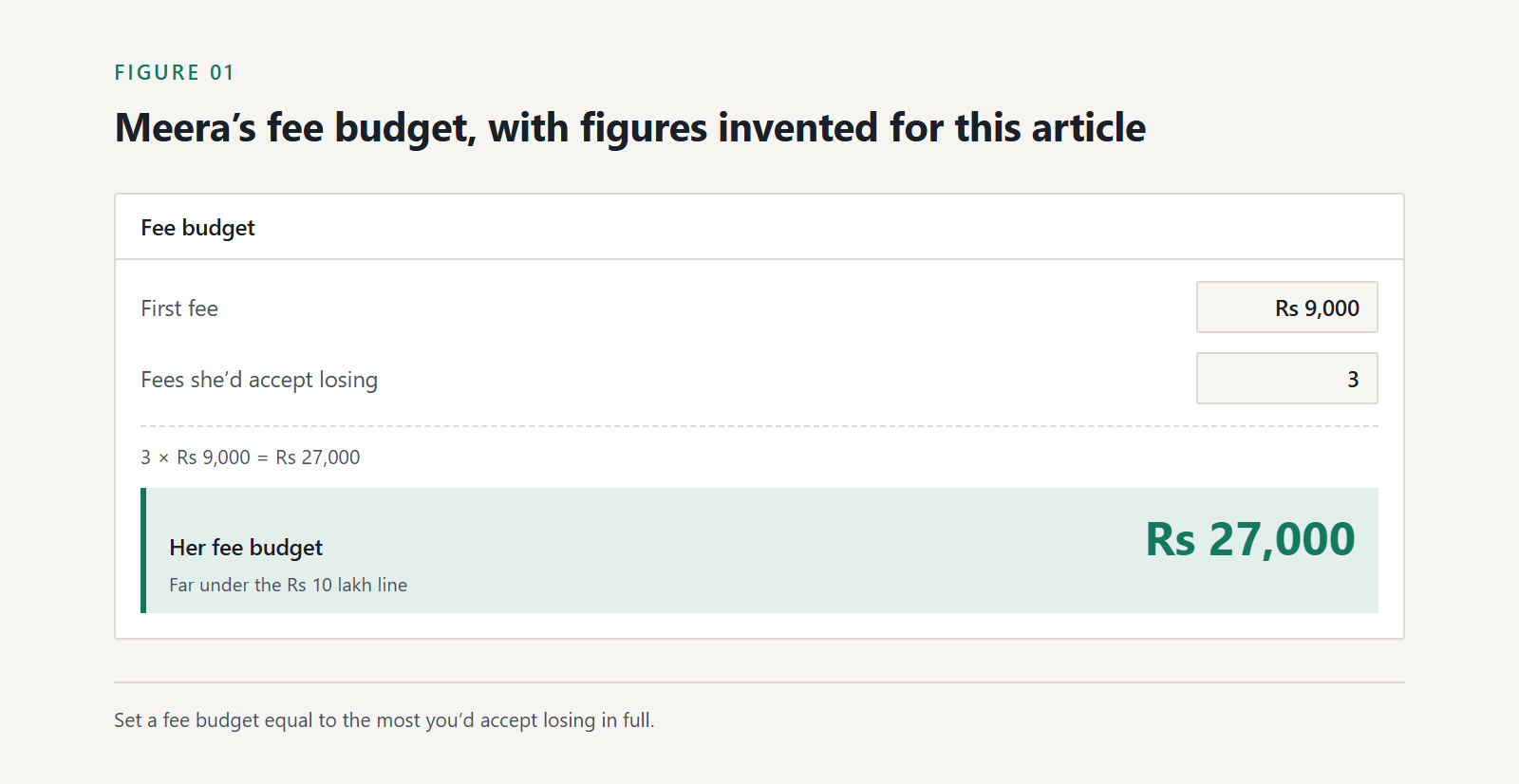
Figure 01. Meera’s fee budget is three fees of Rs 9,000, which is Rs 27,000.
5. Choose how the payout comes home
Take every payout into a bank account or wallet in your own name, by the route whose full cost you can see: the firm’s fee plus the receiving bank’s charges. Bring money held abroad home promptly, instead of leaving large balances there.
Two firms publish their payout routes on their own pages, and, as in step 3, FundedNext appears here only as an example:
THE TERM | FUNDEDNEXT (HELP CENTER, READ 22 OCTOBER 2026; FEE AND LIMIT ARTICLE MODIFIED 12 OCTOBER 2026) | THE5ERS (PAYOUT FAQ, UPDATED 24 AUGUST 2026) |
Routes | USDT, USDC, Confirmo, RiseWorks, bank transfer, card, FNmarkets | Rise, crypto, bank transfer, Hub Credits |
Bank transfer limit | USD 1,000 to 50,000 per request | Set by the receiving bank |
Crypto limit | USD 20 to 1,999 per request in USDT or USDC (general case) | USD 1,500 a payout |
Fee | Up to 3.5% per request | 3.5% a payout, plus receiving-bank fees |
Their stated times stop at the firm. FundedNext commits to processing payouts within 24 hours of the request and says bank-transfer requests are not eligible for its Brand Promise compensation. The5ers says approved requests typically take up to 3 business days.
A stablecoin payout (a crypto token pegged to the US dollar, such as USDT or USDC) lands in a wallet or exchange account before any rupees reach your bank, so how it’s taxed is on the step 7 list for your CA.
Then read the firm on its first payout:
- No payout requested yet: too few to read. Stay within your step 4 budget and buy no larger evaluation from that firm.
- Requested and not yet in your account: hold, and pay that firm no new fee.
- Credited to an account in your name, with the firm’s statement and the bank’s record: go, and you may keep trading with it, within your step 4 budget.
- Paid only into an account in someone else’s name, or every route in yours refused: stop paying its fees.
This test is this article’s own rule of thumb. One credited payout doesn’t show that later ones will be paid.
Meera fails her first evaluation and passes the second: 2 × Rs 9,000 = Rs 18,000 spent, which leaves Rs 27,000 − Rs 18,000 = Rs 9,000, one more fee. Her first payout request is $600, and the firm’s fee is up to 3.5%, so the fee takes at most $21. She takes it by bank transfer into her own savings account and holds it until it lands.
It arrives with the firm’s statement and a FIRC (Foreign Inward Remittance Certificate, the bank’s record of money received from abroad). HDFC Bank’s schedule (undated page, read 22 October 2026) lists no charge for an inward remittance and Rs 200 per FIRC, plus GST. At 18% GST, the certificate costs Rs 236. Neither the $21 at most nor the Rs 236 counts against her Rs 27,000, which covers evaluation fees only. Credited to her own account, the payout is a go for now. Had the firm offered only someone else’s account, it would have been a stop.
6. Work out how the payout is taxed
Before you file, give your CA every fee and payout record, and let the CA decide two things. One is the head of income, the category of income the law taxes the payout under. The other is whether the fees count against the payouts.
One practitioner’s answer is on record: CA Niyati Shah of 1 Finance, in Business Today (2 August 2025). It is a chartered accountant’s opinion, not a regulator’s statement. She writes that earning from international prop firms is “fully legitimate for Indian residents when structured correctly.” Her conditions are a wallet in your own name, clear payout records, timely repatriation, and full disclosure in your return, and she warns that large balances held long in foreign wallets could raise questions under FEMA if not disclosed properly.
On tax, she says payouts from firm-provided capital are best classified as business income, and cites no section or ruling.
So the head, the rate that follows it, and the fees’ treatment are for your CA to confirm against the Income Tax Department’s current text.
Meera asks her CA which head her one payout falls under, and whether her two fees, 2 × Rs 9,000 = Rs 18,000, count against it. She brings the records file described in step 7.
7. Know what to report and keep
Tell your CA about any balance or account you hold abroad, and ask whether a Form 67 applies to you (see below).
The three schedules below come from the ITR-2 manual only. The Income Tax Department’s ITR-2 user manual for assessment year 2026-27 says residents report income from any source outside India in Schedule FSI. Schedule TR summarizes the relief claimed in India for tax paid abroad, and Schedule FA holds details of foreign assets and income from any source outside India.
The department’s Schedule FA page adds that ITR-1 and ITR-4 shouldn’t be used if you have foreign assets. Whether a balance in a foreign wallet or firm account counts as one is on the CA list at the end of this step.
The department’s Form 67 FAQ, last modified 24 September 2025, says Form 67 is required to claim credit for foreign tax paid outside India. It is filed online before the due date under section 139(1), with no CA certificate needed. Section 139(1) is the 1961 Act’s number, so the CA list below asks for this year’s due date.
Your part is the file. Keep one for every firm, holding:
- each fee receipt, with the company named on it
- the terms as they stood when you paid
- each payout statement
- the bank’s credit advice and FIRC
- any wallet or exchange statements
Meera’s file holds two fee receipts, the dated terms, one payout statement, the credit advice and the FIRC. Her payout went straight to her bank, so she holds nothing abroad at the year’s end, and the firm’s statement shows no tax withheld, so Form 67 doesn’t come up. Her CA picks the ITR form.
ITR-2 is not for business income, which step 6 mentions, so which form you use, and whether Schedules FSI, TR and FA apply as described, is for your CA to confirm. Hand your CA these questions as they stand:
- Which head of income do the payouts fall under?
- Do the fees count against the payouts?
- Does a balance in a foreign wallet or firm account count as a foreign asset?
- Is the payout foreign-source income?
- Does Form 67 apply, and what is this year’s due date?
- How is a stablecoin payout treated?
- Which ITR form applies?
The Bottom Line on Prop Trading in India
The sources read give no single yes or no on whether prop trading is legal in India, so for a paid evaluation with a fee abroad, check the firm. Run steps 1 to 5 on the offer in front of you, before and after you pay. Steps 6 and 7 are hand-offs: your CA does the tax work, and your part is the records file from step 7.
Your first action is small. Before your next checkout page, search the firm’s name on the RBI’s own Alert List and open its terms. If you are still choosing a firm, a guide to the top prop firms for Indian traders covers that. Then run steps 1 to 5 on each firm.
Frequently Asked Questions
Do prop firms pay out to traders in India?
No source read gives an India-specific payout count. India was not among the three countries FTMO named as its leading ones for August 2026: the UK, Vietnam and Germany. It gave no country-level totals (Finance Magnates). FundedNext said it paid $15.19 million to 8,340 traders in February 2026, a self-reported, unaudited figure with no country split, while an on-chain tracker recorded about $13 million for that month. Both firms are on the Alert List copy and appear here only for their figures. Use your own first payout, credited to an account in your name, as one check. It doesn’t show that later payouts will follow.
What happens if regulators act against my prop firm?
Support can stop overnight. My Forex Funds, a prop firm, said, as Wealth Professional reported on 10 December 2025, that when its receivership and freezes took effect, its workforce was disbanded and customers lost access to support. That receivership was in Ontario. In the US, a New Jersey court kept $12,080,000 of the corporate defendants’ assets frozen in a CFTC case (FX News Group, 17 November 2023), later dismissed with prejudice after a Special Master found the CFTC made false representations to the court (Willkie Farr & Gallagher LLP, 26 May 2025). These reports don’t say what happened to traders’ payouts. For you, they show that a firm’s support can stop, so keep fees inside your step 4 budget.
Does the Budget 2026 TCS cut to 2% cover prop firm fees?
Kotak’s table gives no row for an evaluation fee. Kotak Mahindra Bank (undated FAQ, read 22 October 2026) says the Union Budget 2026 cut TCS from 20% and 5% to 2% from 1 April 2026, but only for education and medical remittances above Rs 10 lakh and overseas tour packages. Any other purpose stays at 20% above Rs 10 lakh. Ask your bank which purpose it will record.
Do I pay GST on a prop firm’s evaluation fee?
The GST portal says Form GSTR-5A is the return an overseas provider files for services to non-taxable persons in India, including online information and database access or retrieval services. It doesn’t say whether an evaluation counts as such a service, or whether your fee carries GST. If it does, the filing sits with the firm, so check the invoice for any GST line.
RISK DISCLAIMER
Risk disclaimer: Prop trading involves financial risk, including the loss of evaluation fees if you fail a challenge.