SEO for Prop Firms and Forex Brokers
A prop firm or a broker cannot buy attention the way most businesses do. Because the major ad platforms restrict this category, so a large share of the traffic has to be earned rather than bought.
This makes search the default channel, and many firms spend it badly. SEO for prop firms and forex brokers means building the pages that answer what traders ask before they choose a firm, and sites usually skip them in favour of a homepage and a few market outlook posts.
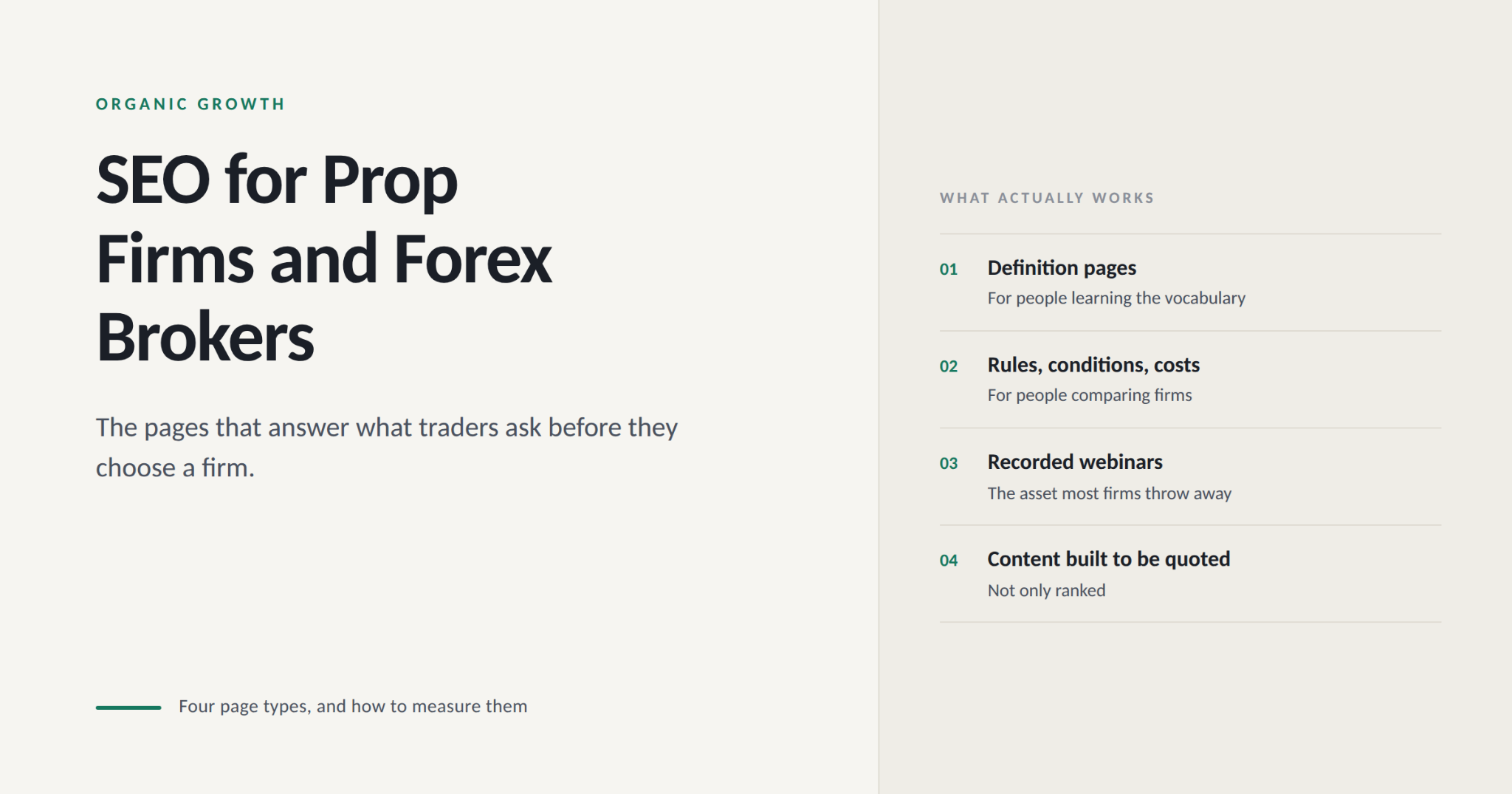
Four page types do most of the work here:
- definition pages, for people still learning the vocabulary
- rules, conditions and cost pages, for people comparing firms
- recorded webinars, the asset most firms throw away
- content built to be quoted by AI assistants, not only ranked
This guide explains the relevance of all these and also how to tell whether any of it is working or not.
What someone searches before they pick a firm
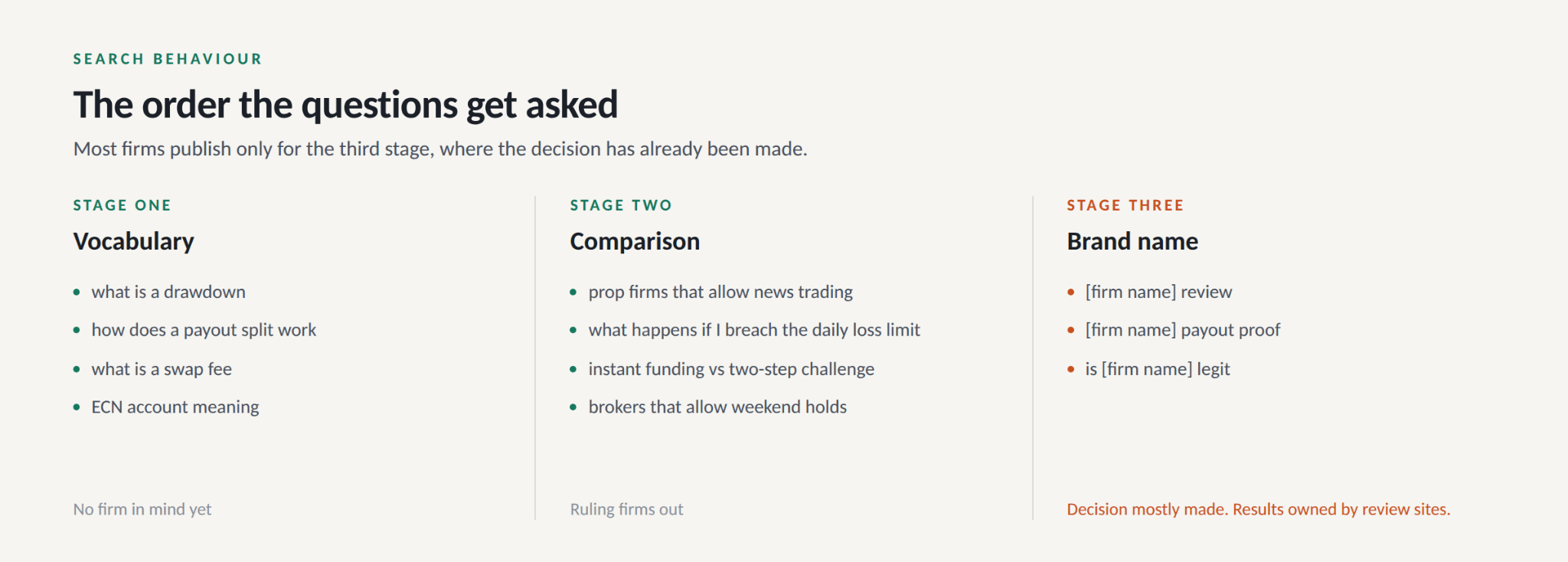
Prop firm SEO and forex broker SEO run on the same logic, because the decision follows the same path. Watch the order in which the questions get asked.
The vocabulary questions come first: What a drawdown is. How a payout split works. What a swap fee does. What an ECN account means. The person asking these has no firm thing in mind and may not have decided whether to trade at all.
Then the comparison questions: Which prop firm allows news trading. What happens if the daily loss limit is breached. Instant funding or a two-step challenge. Which broker lets a position run over the weekend. Here, the field has narrowed and the reader is looking for reasons to rule firms out.
The brand name comes last. Searches for your firm plus "review" or "payout proof" are the final step, and by then the decision is generally made.
Many firms publish only for that final step. It is the one stage where the choice has already been made, and where the results are dominated by review sites and forums that your firm doesn't control.
Definition pages: the layer most firms skip
Once a site has enough authority to support them, build one page per term instead of a long glossary. A page about drawdown can rank for drawdown, but a glossary holding forty terms competes properly for none of them, because no single section is strong enough to win on its own.
Answer in the first two sentences: Say what the term means plainly, then give the context underneath. A reader who has to scroll to find the definition leaves before they get there.
Use real numbers: A worked example beats a description. Show a $100,000 account with a 5% daily loss limit and what happens at $95,000, rather than explaining the idea in the abstract.
Start with the terms your support team has to keep explaining: The questions arriving by live chat are the ones being typed into Google, and they cost nothing to collect.
Link onward: Every definition page should point to the page where the reader can act, which for a prop firm is usually the rules or challenge page, and for a broker the account types page.
Remember that these pages bring volume rather than sign-ups. So, judge them on registrations after two months. Their job is to bring people in and to build the topical depth that helps everything else rank. Our forex trading glossary shows this format at work.
Rules, conditions and costs: the pages that convert
This is where the two audiences split, and where majority of the sign-ups come from.
Prop firms should publish | Brokers should publish |
Challenge rules and how the drawdown is calculated | Spreads by account type |
Payout splits and the payout schedule | Commission per lot |
Scaling plans | Swap and overnight charges |
Country eligibility | Withdrawal fees and processing times |
What happens when a rule is breached | Which regulated entity serves which country |
That last row on the prop firm side gets asked constantly and answered almost nowhere.
One rule covers both columns: Publish the actual number.
"Competitive spreads" and "industry-leading payouts" rank for nothing, because nobody searches for them. "EURUSD spread from 0.6 pips on the standard account" can be found, compared and quoted. Put the figures in a table, because a reader comparing three firms will copy the table rather than the paragraph.
Note that these pages rank for a dull reason: Many competitors answer the same questions vaguely, which leaves the specific answer unclaimed. A page that states the daily loss limit, shows how it is measured and gives an example of a breach will beat a rival's marketing copy on the same subject without any link building.
They also do a second job: Someone who understands your terms before signing up complains less afterwards, and that shows up in your support load and in what people write about you.
Recorded webinars: the asset many firms waste
Most of the firms run a webinar, put the replay behind a form, and let it disappear.
The session already cost money in preparation and presenter time. The words in it are already written and publishing them properly costs almost nothing.
- Give every session its own page.
- Title it as a question someone would type, not just"Weekly Market Update, 14 March".
- Publish the full transcript and add timestamps so the page is usable.
- Write out the audience questions and the answers, because those are the phrasings people search for.
The transcript is what ranks. An hour-long session contains several thousand words on one topic, which is more depth than most firms manage in a written article.
Keep the form if you need the lead, but keep it off the transcript..
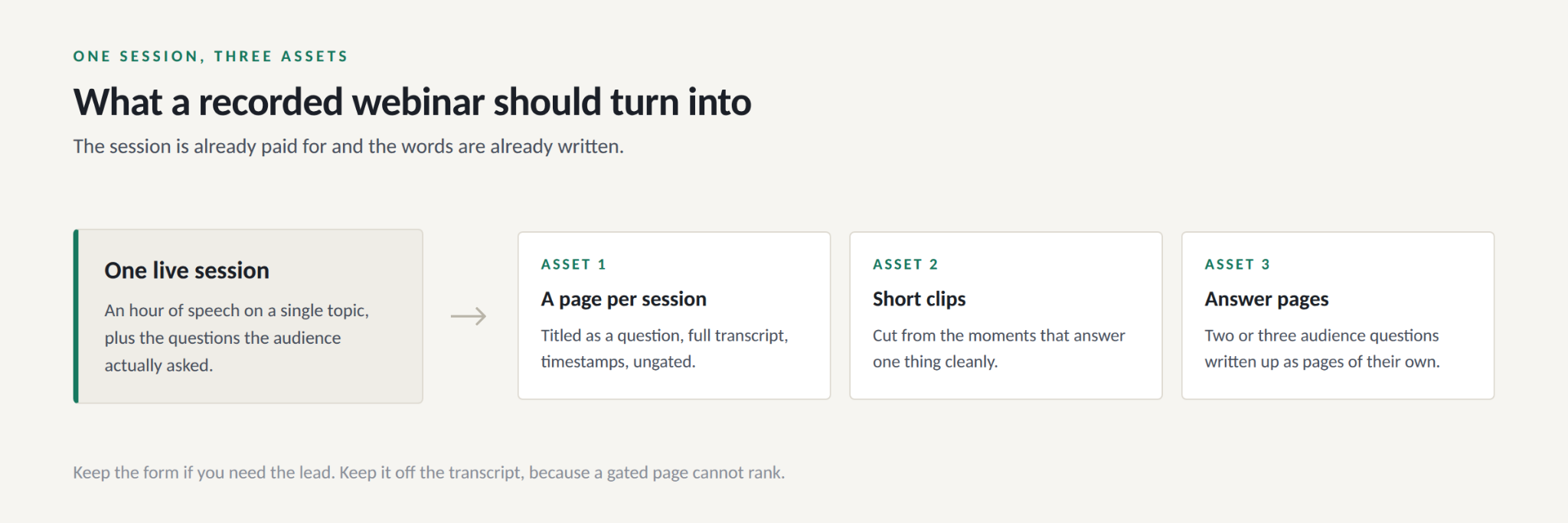
One session usually produces three assets: the page itself, several short clips, and two or three written answers that become pages of their own.
Our webinars directory collects where a number of brokers publish their sessions, which is a quick way to see the formats in use.
Getting cited, not just ranked
Getting cited by ChatGPT or Perplexity is a different than ranking first, and a growing share of questions now get answered before anyone clicks. These assistants read several sources, summarise them, and name a few. The question becomes whether you are one of the sources being quoted.
Five things can make your content easy to quote:
- A direct answer up front: The first two sentences should stand on their own if lifted.
- Specific figures: "Most firms pay out within 14 days" is quotable. "Fast payouts" is not.
- A named author with credentials: Anonymous content is difficult to cite and easy to skip.
- A visible date: Assistants prefer content they can place in time.
- Traceable claims: Where a number comes from a regulator or an exchange, say so and link it.
This matters more here than in other categories. Google classes anything that could affect someone's financial stability as a ‘Your Money or Your Life’ topic, and says its systems give more weight to experience, expertise, authoritativeness and trust on those subjects. A prop firm or broker site lies squarely inside that definition, so the five points above are not stylistic preferences.
Doing all of this consistently is slow work sitting between content, compliance and engineering. It is rarely a skills problem and almost always a capacity one, which is why firms bring in agencies offering fintech SEO services for this layer than for writing blog posts.
What to measure, and why it is difficult
Organic has an attribution problem that paid does not, and it catches most teams out.
The lag: A page published in March may produce nothing until September. Anything judged on a quarterly cycle gets cancelled before it works.
The branded search effect: Someone reads your definition page, remembers the name, and searches your firm directly a week later. The sign-up is credited to branded search. The page that caused it shows one visit, no conversion, and looks like a failure.
Three things that must be tracked:
- Branded search volume over time, because it rises when the earlier pages are doing their job.
- Assisted conversions rather than last click, so the pages that start the journey get counted.
- AI search visibility for brokers and prop firms is not yet well served by tools, so check by hand once a month which of your pages appear in AI answers for your main questions.
Rankings on their own tell very little. A report full of green arrows can stay alongside a quarter in which nothing was sold.
Frequently Asked Questions
How do I know it is working before it produces sign-ups?
The early signals arrive in a fixed order: impressions before clicks, long-tail phrases before head terms, and definition pages before the pages that convert. If impressions on your rules and cost pages are climbing while clicks stay flat, the titles are the problem. If neither moves after four months, the problem is authority rather than content.
Is a single glossary page ever the right call?
Yes, on a new site. Thirty thin pages on a domain with no authority will sit unindexed or compete with each other, and one well-built glossary gives the crawler a single strong page instead. Split it into separate pages once individual terms start ranking and the page has grown awkward to read.
Which parts can a small team realistically keep in-house?
The rules, conditions and cost pages, because nobody outside the firm knows the terms well enough to write them accurately. Technical work, authority building and anything requiring consistent weekly output usually go outside.